Internal Medicine Montefiore St. Luke's Cornwall Wappingers Falls, New York, United States
Introduction/Background: Stroke remains a leading global cause of morbidity and mortality. Mechanical thrombectomy (MT) is an essential intervention for acute ischemic stroke. However, multiple factors influence its success and outcome.
Objectives: This study evaluates factors linked to successful MT and its impact on stroke outcomes.
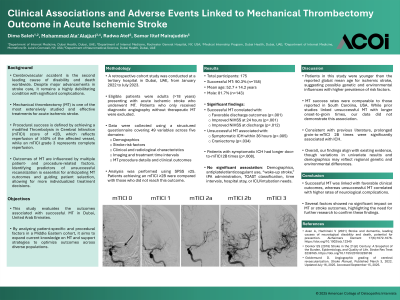
Methods: A retrospective cohort study was conducted at Rashid Hospital, Dubai, United Arab Emirates, involving 175 adult patients (≥18 years) diagnosed with acute ischemic stroke who underwent therapeutic MT between January 2022 and July 2023. Participants are categorized into two groups based on MT success, defined as an mTICI score ≥2B. The main outcomes include in-hospital complications such as intracranial hemorrhage and improvement in functional status measured by the NIHSS scoring system.
Results/Discussion: Successful MT was achieved in 90.3% (n=158) of cases. The mean age was 52.7 ± 14.2, and 81.7% (n=143) were male. No significant associations were found between MT outcome and factors such as anticoagulants/antiplatelets usage, “wake-up stroke” presentation, tPA administration, TOAST classification, time intervals, hospital stay duration, or ICU/intubation needs. However, successful MT was significantly associated with favorable discharge outcomes (p < 0.001), improved NIHSS scores at 24 hours of admission (p < 0.001), and at discharge (p=0.012). Alternatively, unsuccessful MT was linked to a higher incidence of symptomatic intracranial hemorrhage (p=0.005) and craniectomy (p=0.034).
Conclusions: Successful MT was associated with improved neurological outcomes, while its failure was linked to higher rates of neurological complications. Interestingly, multiple factors did not significantly influence MT or stroke outcomes, warranting further research to validate these findings.

.jpg "Mohammad Alajjuri, MD photo")