Internal Medicine OhioHealth Doctors Hospital Columbus, Ohio, United States
Introduction/Background: Standardizing the Intensive Care Unit (ICU) transfer process improves communication and reduces medical errors. Tully et al. (2019) reported medication errors in nearly 50% of patients transferring from ICU to non-ICU settings. Structured handoff programs like I-PASS have been shown to reduce adverse events by 47% (Starmer et al., 2022). The American College of Critical Care Medicine emphasize clear communication during all patient transfers. This QI study’s aim was to evaluate the effectiveness of communication strategies in promoting adherence to ICU transfer safety protocols.
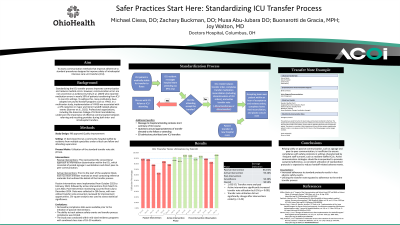
Methods: This IRB-approved QI study was conducted in a 17-bed closed ICU at a community hospital. Residents from various specialties rotated through under critical care physician supervision. A protocol using a standardized ICU transfer note was reinforced through passive interventions (signage, peer-to-peer communication) from October 2023 to February 2024 and active interventions (email reminders) from March through June 2024. Post-intervention surveillance ran from July through December 2024. Utilization data, collected via Qlik Sense, was reviewed monthly. A 90% monthly utilization rate was defined as successful process adherence.
Results/Discussion: 1,433 ICU transfers were analyzed. Overall utilization was 90.5% (1,298). During the passive intervention phase, average utilization was 85.1% (range: 64.1%–89.3%) and did not meet 90% adherence during any month. With active interventions, average utilization rose to 93.2% (range: 79.6%–96.4%), meeting 90% adherence in three of four months. In the six-month post-intervention period, average utilization increased to 94.3% (range: 83.6%–97.4%), with 90% adherence met in four of six months.
Conclusions: Relying on passive communication alone is insufficient to ensure compliance with safety protocols in environments with frequent resident turnover. Active communication methods should be integrated for sustained adherence. Consistent utilization of standard safety protocols should lead to reduced handoff-related adverse events.