Internal medicine University of Tennessee Medical Center Knoxville, Tennessee, United States
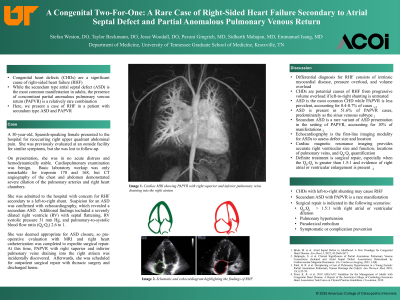
Clinical Scenario or Case: A 30-year-old, Spanish-speaking-only female presented to the hospital with shortness of breath and right upper quadrant abdominal pain. She was previously evaluated at an outside facility for similar symptoms, but she was lost to follow-up. On presentation, CT angiography revealed severe dilation of the pulmonary arteries and right heart chambers. She was admitted to the hospital with concern for right heart failure (RHF) secondary to a left-to-right shunt. Suspicion for atrial septal defect (ASD) was confirmed with echocardiography, which revealed a secundum ASD. She was deemed appropriate for ASD closure, but pre-operative evaluation with MRI incidentally revealed partial anomalous pulmonary venous return (PAPVR). Ultimately, she was scheduled for surgical repair.
Evidence/Literature Review: Congenital heart defects (CHDs) are a cause of RHF from progressive volume overload if left-to-right shunting is left untreated. Here, our patient developed RHF secondary to chronic shunting from a rare variant of ASD presentation in the setting of PAPVR, a combination that accounts for only 10% of manifestations. Echocardiography is the first-line imaging modality to ASDs, and definitive treatment is surgical repair, especially when there is evidence of right-sided enlargement.
Unique Aspects of Case: While the secundum ASD is the most common manifestation in adults, the presence of concomitant PAPVR is a relatively rare combination. Here, we present a case of RHF in an uninsured, Spanish-speaking-only female with secundum ASD and PAPVR to highlight the importance of developing a safe treatment plan to prevent mortality in an underserved patient population.
Recommendations/Conclusions: Heart failure is a significant cause of mortality in adults with CHDs. Prompt intervention is necessary to prevent irreversible dysfunction. In populations that are at high risk to be lost to follow-up, appropriate measures must be employed to overcome potential barriers to care.