Medical Student Lincoln Memorial University DCOM Germantown, Tennessee, United States
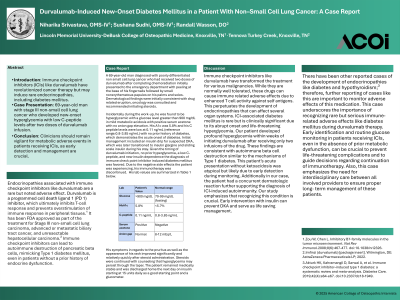
Clinical Scenario or Case: A 69 year old man diagnosed with poorly differentiated non small cell lung cancer who had received 2 doses of Durvalumab (Imfinzi) after completing chemoradiation. He initially presented to the emergency department with small nonerythematous papules on his palms and soles, which were initially consistent with drug related eruption, and steroids were initiated after oncology consult. Incidentally during the work-up, he was found to be hyperglycemic with a glucose level greater than 900, mild metabolic acidosis with no anion gap elevation. His A1c was 5.8 and his C peptide levels were low at 0.11 (0.8-3.85) with no prior history of diabetes. Initial management included an insulin drip for suspected DKA. Given the timing of Durvalumab initiation, low C-peptide, and new insulin dependence the diagnosis of immune check point inhibitor induced diabetes mellitus was favored. Due to the negative side effects he was experiencing, his immunotherapy was discontinued.
Evidence/Literature Review: Endocrinopathies associated with immune checkpoint inhibitors like Durvalumab (Imfinzi) are a rare but noted adverse effect. Durvalumab is a programmed cell death ligand 1 (PD 1) inhibitor, which ultimately inhibits T-cell response and prevents overstimulation of immune response in peripheral tissues¹. Immune checkpoint inhibitors can lead to autoimmune destruction of pancreatic beta cells, mimicking Type 1 diabetes mellitus, even in patients without a prior history of endocrine dysfunction.
Unique Aspects of Case: Our patient developed profound hyperglycemia within weeks of initiating Durvalumab after receiving only 2 infusions of the drug. These findings are consistent with autoimmune beta cell destruction similar to the mechanisms of Type 1 diabetes. Our patient’s acute presentation without ketoacidosis was atypical but likely due to early detection during monitoring. Additionally, the patient had a concurrent dermatologic reaction further supporting ICI-induced autoimmunity.
Recommendations/Conclusions: Clinicians should remain vigilant for metabolic adverse events in patients receiving ICIs, as early detection and management are crucial.