NA Des Moines University West Des Moines, Iowa, United States
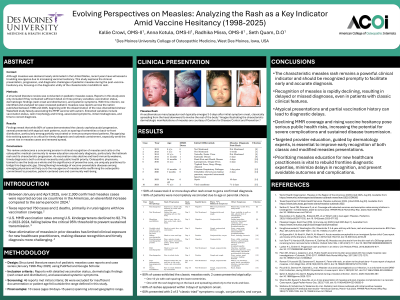
Introduction/Background: Although measles was declared nearly eliminated in the United States, recent years have witnessed a troubling resurgence due to increasing vaccine hesitancy. This study explores the clinical presentation, progression, and diagnostic challenges of pediatric measles during the post-vaccine-hesitancy era, focusing on the diagnostic utility of the characteristic morbilliform rash.
Methods: A structured literature review was conducted on pediatric measles cases. Reports in this study were only included if they contained sufficient detail on three primary variables: vaccination status, dermatologic findings (rash onset and distribution), and systemic symptoms. With this criterion, we identified and analyzed ten peer-reviewed pediatric measles case reports across the nation published between 1998 and 2025, beginning with the dissemination of the now-discredited Andrew Wakefield study falsely associating the MMR vaccine with autism. Extracted variables include vaccination status, rash morphology and timing, associated symptoms, initial misdiagnoses, and time to correct diagnosis.
Results/Discussion: Findings reveal that while 80% of cases demonstrated the classic cephalocaudal progression, several presented with atypical rash patterns, such as sparing of extremities or back-to-front distribution, particularly among partially vaccinated or immunocompromised patients. Recognizing this evolving spectrum is critical for timely diagnosis and outbreak containment, especially amid the current rise in measles cases and renewed spread.
Conclusions: This review underscores a concerning erosion in clinical recognition of measles and calls on the osteopathic medical community to renew education around early diagnosis, particularly the hallmark rash and its characteristic progression. As vaccination rates decline and herd immunity weakens, timely diagnosis is both a clinical necessity and public health priority. Osteopathic physicians, trained to see the body as a whole and the significance of preventive care, are uniquely positioned to bridge this diagnostic gap. Strengthening knowledge of vaccine-preventable diseases among emerging physicians will help curb the resurgence of measles while reaffirming the osteopathic commitment to proactive, patient-centered care and community well-being.