Medical Student Alabama College of Osteopathic Medicine Coral Springs, Florida, United States
Introduction/Background: HIV infection remains a significant global health challenge, leading to acquired immunodeficiency syndrome (AIDS) and an increased risk of cardiovascular and pulmonary diseases despite effective antiretroviral therapy (ART). Chronic immune activation and inflammation contribute to a hypercoagulable state, increasing the risk of thrombotic events. Understanding these molecular disruptions is crucial for developing strategies to reduce comorbidities in HIV-infected patients.
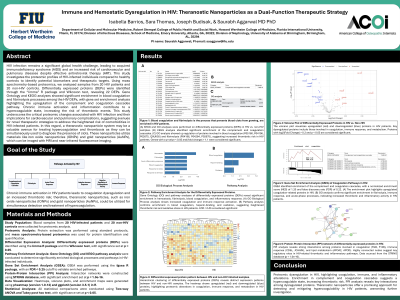
Methods: This study investigates the proteomic profiles of HIV-infected individuals compared to healthy controls to identify potential biomarkers and therapeutic targets. Using mass spectrometry-based proteomics, plasma samples from 20 HIV patients and 20 non-HIV controls were analyzed. Differentially expressed proteins (DEPs) were identified using the “limma” R package and Wilcoxon test. Gene Ontology (GO), KEGG pathway, and gene set enrichment analyses were conducted to characterize biological processes and pathways affected in HIV.
Results/Discussion: A total of 22 DEPs were identified. GO and KEGG analyses showed significant enrichment in blood coagulation and fibrinolysis pathways. Gene set enrichment analysis further highlighted upregulation of the complement and coagulation cascades. These findings suggest that HIV infection is associated with activation of clotting and immune pathways, which may contribute to cardiovascular and thrombotic complications.
Conclusions: This study underscores critical proteomic changes linked to HIV infection, supporting the presence of a hypercoagulable and inflammatory state. Theranostic nanoparticles—such as iron oxide (IONPs) and gold nanoparticles (AuNPs)—may offer a promising dual-function strategy for diagnosis and treatment. These nanoparticles can be used to detect clots via MRI and near-infrared fluorescence imaging, while simultaneously delivering targeted therapies to mitigate thrombosis in HIV patients.