Medical Student Ohio University Heritage College of Osteopathic Medicine - Dublin Hilliard, Ohio, United States
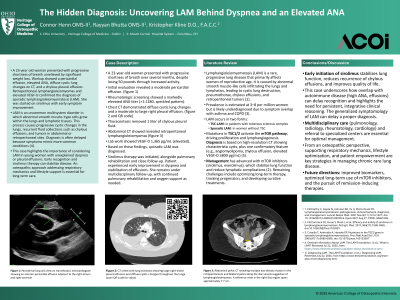
Clinical Scenario or Case: A 23-year-old woman presented with worsening shortness of breath over several months. Despite losing 50 pounds through increased activity, her symptoms did not improve. She was referred to cardiology, where evaluation revealed a moderate pericardial effusion, prompting screening for rheumatologic and autoimmune diseases, including a markedly elevated ANA titer (>1:1280, speckled pattern). Chest CT showed diffuse cystic lung changes and a moderate to large right pleural effusion. Thoracentesis drained 1 liter of chylous fluid, confirming a chylothorax. Further evaluation revealed retroperitoneal lymphangioleiomyomas and an elevated VEGF-D (1,365 pg/mL). The diagnosis of sporadic lymphangioleiomyomatosis (LAM) was made, and sirolimus was started, leading to early symptom improvement.
Evidence/Literature Review: LAM is a rare, progressive lung disease affecting primarily women of childbearing age. It results from abnormal smooth muscle–like cell proliferation, often due to mutations in TSC1 or TSC2 genes, which cause unchecked mTOR pathway activation. This leads to cystic lung destruction, chylous effusions, and extrapulmonary lymphatic tumors. Sirolimus (rapamycin), a mTOR inhibitor, is the standard of care for patients with symptomatic or progressive disease.
Unique Aspects of Case: The patient initially attributed her dyspnea to deconditioning and obesity, delaying further evaluation. Early clinical management focused on possible reactive airway disease. The co-occurrence of pericardial and chylous pleural effusions, along with the markedly elevated ANA, raised suspicion for autoimmune disease and briefly diverted the diagnostic process. Ultimately, high-resolution imaging, VEGF-D testing, and identification of retroperitoneal lymphangioleiomyomas led to the diagnosis of LAM. Her case underscores how overlapping features with more common conditions can obscure rare diagnoses without persistent, integrative clinical thinking.
Recommendations/Conclusions: LAM should be considered in young women with unexplained dyspnea, pleural effusions, or cystic lung disease. Early recognition and treatment with sirolimus can stabilize disease. A holistic, osteopathic approach focusing on respiratory mechanics, lifestyle change, and patient empowerment is essential in managing chronic rare lung diseases.