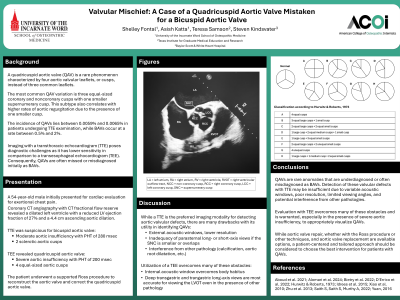
Clinical Scenario or Case: A 54-year-old male initially presented with exertional chest pain. CCTA revealed a dilated LV with a reduced LVEF and an ascending aortic dilation. TTE showed severe AI and sclerosing of the aortic cusps, hinting at a potential BAV. Follow-up TEE confirmed the severe AI; however, it also revealed four aortic valvular leaflets, identifying a QAV rather than a BAV. A supported Ross procedure was performed to reconstruct the aortic valve and the patient improved symptomatically. Follow-up TTE revealed improvement to mild AI but persistent severe global hypokinesis with reduced LVEF. Guideline-directed medical therapy was initiated for close follow-up.
Evidence/Literature Review: QAV results from abnormal septation of the distal bulbus cordis, creating a supernumerary cusp (SNC) in addition to the usual left, right, and non-coronary cusps. Hurwitz and Roberts classify eight morphologic subtypes, the commonest featuring three equal cusps plus a smaller SNC; fewer than 400 cases have been reported. Accurate diagnosis is challenging as TTE may miss a small SNC because of suboptimal acoustic windows, overlapping cusps, or coexistent pathology, leading to misclassification as BAV. TEE, with superior esophageal and transgastric views, reliably delineates all four cusps and should be pursued whenever significant aortic insufficiency is present or valve morphology is uncertain.
Unique Aspects of Case: This case underscores that definitive imaging can redirect surgical planning. Ongoing research is needed to clarify QAV embryology and to refine diagnostic algorithms comparing TTE and TEE.
Recommendations/Conclusions: Quadricuspid aortic valves are rare and frequently mistaken for bicuspid valves on transthoracic echocardiography, whose limited windows, resolution, and angles often obscure a small supernumerary cusp; transesophageal echocardiography should therefore be pursued to ensure accurate visualization and diagnosis. Management must be individualized, balancing repair and replacement options, while further research clarifies QAV etiology and refines comparative diagnostic efficacy between TTE and TEE.