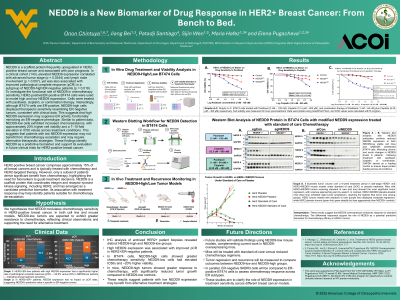
Introduction/Background: NEDD9 is a scaffold protein upregulated in HER2-positive breast cancer. In a clinical cohort, elevated NEDD9 expression was significantly correlated with advanced stages (p = 0.0344) and showed a trend toward increased lymph node involvement (p = 0.057). Interestingly, high NEDD9 expression was also associated with improved pathological complete response (pCR) in the ER-negative subgroup (p = 0.018), suggesting a context-dependent role in therapeutic sensitivity.
Methods: HER2-positive/ER-positive BT474 cells were used to model high and low NEDD9 expression levels. Cells were treated with paclitaxel (0–128 nM), cisplatin (0–800 uM), or combination therapy (each drug at half-dose).
Protein lysates were analyzed using NEDD9 antibodies. High and low NEDD9 cell lines were generated using CRISPR-based sgNEDD9 knockout and siRNA-based siNEDD9 knockdown, respectively, to model chronic and acute NEDD9 depletion.
MMTV-Cre-Her2-NEDD9 and MMTV-Cre-Her2 transgenic mice were used to represent high and low NEDD9 expression, respectively. Each received either no treatment or standard-of-care chemotherapy.
Results/Discussion: NEDD9-low cells displayed a 7–10-fold increase in chemoresistance across all treatments. Although BT474 cells are ER-positive, high-NEDD9 cells exhibited response patterns similar to ER-negative tumors, suggesting that high NEDD9 expression suppresses ER levels in later stages.
Western blot confirmed effective NEDD9 knockdown in sgNEDD9 and siNEDD9 cells. In paclitaxel-treated cells, NEDD9 levels dropped with increasing drug concentration and reduced viability. In cisplatin-treated cells, NEDD9 reduction was due to direct effects on transcription or translation, not cell loss. Clinically, rapid NEDD9 loss may reduce chemotherapy response in initially NEDD9-high patients, lowering pCR rates and contributing to resistance.
In the mouse model, tumors in the NEDD9-high group progressed more rapidly than controls. However, these tumors also responded more robustly to chemotherapy, consistent with the clinical dataset.
Conclusions: These findings suggest that patients with low NEDD9 expression may not benefit from chemotherapy escalation and could require alternative therapeutic approaches.