Internal Medicine Montefiore St. Luke's Cornwall Wappingers Falls, New York, United States
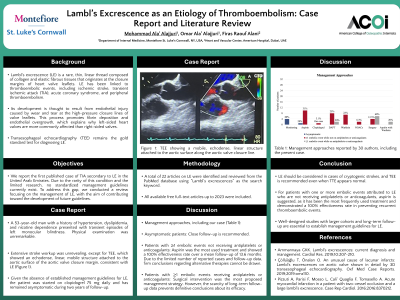
Clinical Scenario or Case: A 53-year-old male presented with transient attacks of left monocular blindness. Extensive stroke work-up was negative, except for TEE, which showed an echo-dense linear mobile structure attached to the aortic surface of the aortic valve closure margin, suggesting LE. As no guidelines exist on the management of LE, patient was started on Clopidogrel 75 mg daily and remained asymptomatic for 2 years.
Evidence/Literature Review: Lambl’s excrescence (LE), a linear fibrous thread of collagen and elastic fibrous tissue originating at closure margins of heart valve leaflets is considered a rare cause of thromboembolism. Transesophageal echocardiography (TEE) is the gold standard for diagnosing LE. Due to the rarity of the disease, no guidelines exist about its management. Twenty-two papers about LE were reviewed using the PubMed database using “Lambl’s excrescences” as a keyword. All free full-text papers up to 2023 were retrieved. Close follow-up is recommended for asymptomatic patients. Aspirin was the most used and recommended treatment option for patients with ⩾1 embolic event while not on antiplatelets or anticoagulants with effectiveness rate of 100%. A proper conclusion about other treatment options for this group cannot be formulated as the follow-up data were limited. For patients with ⩾1 embolic event while on antiplatelets or anticoagulants, the most frequent treatment suggested was surgical intervention. Follow-up in this group is limited which hinders a significant conclusion.
Unique Aspects of Case: We present the first published case of TIA secondary to LE in the United Arab Emirates. A literature review was conducted focusing on the management aspect of LE aiming to assist in guideline publication.
Recommendations/Conclusions: Clopidogrel was effective in preventing recurrent thromboembolic events as Aspirin for patients with ⩾1 embolic event attributed to LE while not on antiplatelets or anticoagulants. Well-designed studies with long-term follow-up are needed to establish management guidelines.

.jpg "Mohammad Alajjuri, MD photo")