(18-RES) Difficulty with clinical differentiation between two markedly similar urologic presentations: balanitis xerotica obliterans vs. penile calciphylaxis
Internal Medicine Kettering Health Dayton Dayton, Ohio, United States
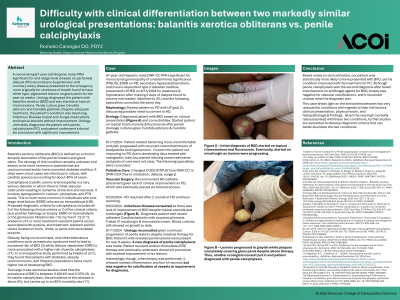
Clinical Scenario or Case: A nonsmoking 67-year-old Hispanic male PMH significant for end-stage renal disease on peritoneal dialysis secondary to hypertension and coronary artery disease presented to the emergency room originally for shortness of breath found to have white hypo-pigmented lesions on glans penis for the past six weeks. Urology diagnosed the patient with balanitis xerotica (BXO) and was started on topical triamcinolone. Penile culture grew Candida albicans and Candida glabrata. Despite adequate treatment, the patient’s condition was devolving. Thus, Infectious Disease trialed anti-fungal medications and topical steroids without improvement. Urology ultimately diagnosed the patient with penile calciphylaxis (PC) and patient underwent a dorsal slit procedure with significant improvement.
Evidence/Literature Review: Diabetes mellitus is a well-known risk factor for both BXO and PC. Obesity, being uncircumcised, and other edematous conditions such as nephrotic syndrome tend to lead to increased risk of BXO (2) while dialysis-dependent ESRD is more associated with a higher risk of penile calciphylaxis (11). In an observational, descriptive, and retrospective study performed by Fekete et al (1), they found that patients with diabetes, obesity, uncircumcision, and Hispanic populations had a much higher risk of developing BXO.
Unique Aspects of Case: Based solely on clinical history, our patient was statistically more likely to have presented with BXO, yet his condition improved with the treatment for PC. Although penile calciphylaxis was the second diagnosis after failed improvement on antifungal agents for BXO, biopsy was negative for vascular calcifications and it remained unclear what the diagnosis was.
Recommendations/Conclusions: This case sheds light on the similarities between two very rare painful conditions with regards to their risk factors, clinical presentation, physical exam, and histopathological findings. Further studies are warranted to develop diagnostic criteria that can better elucidate the two conditions.