(81-RES) Evaluation of time to therapeutic PTT and overall outcomes of patients presenting with pulmonary emboli and treated with heparin infusion with or without heparin bolus.
Internal Medicine University of Tennessee Graduate School of Medicine Knoxville, Tennessee, United States
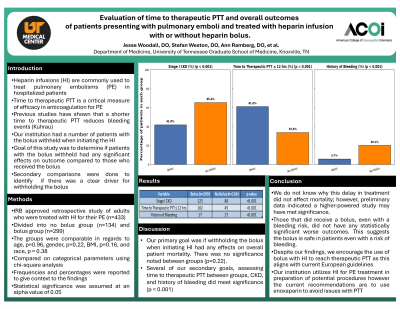
Introduction/Background: Heparin infusions (HI) are commonly used to treat pulmonary embolisms (PE) in hospitalized patients. Time to therapeutic PTT is a critical measure of efficacy in anticoagulation for PE, and previous studies have shown that a shorter time to therapeutic PTT reduces bleeding events (Kuhrau). Our institution had a number of patients with the bolus withheld when initiating the HI for often unclear reasons. The primary goal of this study was to determine if patients with the bolus withheld had any significant effects on outcome compared to those who received the bolus. Secondary comparisons were done to identify any clear driver for withholding the bolus.
Methods: Our retrospective study included two sets of patients who were treated with HI for their PE, no bolus group (n=134) and bolus group (n=299). Charts were surveyed for demographic information, CKD, time to therapeutic PTT, and overall outcomes. The treatment groups were compared using chi-square analysis. Statistical significance was assumed at 0.05.
Results/Discussion: The groups were comparable in age, p=0.96, gender, p=0.22, BMI, p=0.16, and race, p = 0.38. There were significant differences between the groups for Stage I CKD (Bolus [41.8%] vs. no Bolus [65.4%], p< 0.001), Time to Therapeutic PTT > 60, between 0-12 hours (Bolus [61.0%] vs. no Bolus [33.6%], p< 0.001), and bleeding history (Bolus [5.7%] vs. no Bolus [20.1%], p< 0.001). No differences detected between the groups for PESI score (p=0.40) or mortality (p = 0.22).
Conclusions: Our primary goal was to see if withholding the bolus had any effects on overall patient mortality. There was no significance noted between groups (p=0.22). Second, we found that 61% of the bolus group became therapeutic within 12 hours compared to only 33.6% of the no bolus group (p < 0.001). Other studies indicate this has better treatment outcomes; therefore, we encourage use of the bolus.