Osteopathic Medical Student OMS II Rocky Vista university Colorado Englewood, Colorado, United States
Introduction/Background: Diabetic retinopathy (DR) remains a leading cause of preventable blindness, particularly in underserved populations. Timely diagnosis and treatment depend on early diabetes detection and consistent access to routine care; both of which may be influenced by social determinants such as insurance coverage. However, regional data on DR screening adherence remain limited, making it difficult to quantify disparities in preventive eye care.
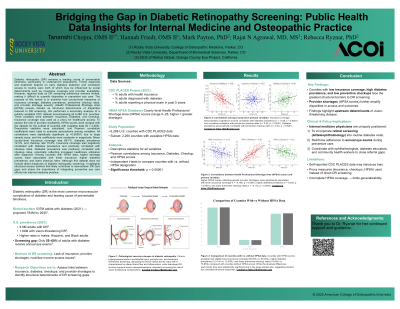
Methods: We performed a secondary analysis of a publicly available CDC dataset encompassing all 6,288 U.S. counties. Three variables were selected: Insurance (percentage of adults with health insurance), Diabetes (percentage of adults diagnosed with diabetes), and Checkup (percentage who had a physical exam in the past five years). Insurance coverage was used as a proxy for healthcare access and broader social determinants of health. Descriptive statistics were calculated, and Pearson correlation coefficients were used to evaluate associations among variables. All correlations were statistically significant (p < 0.00001 selected due to large sample sizes) and the coefficients were moderate in magnitude.
Results/Discussion: The mean insurance coverage was 89.7% (SD 5.41), diabetes prevalence 12.3% (SD 2.79), and checkup rate 75.2% (SD 3.83). Insurance coverage was moderately negatively correlated with diabetes prevalence and positively correlated with checkup rates. Diabetes prevalence also showed a positive correlation with checkup rates, potentially reflecting increased utilization after diagnosis rather than engagement in preventive care. These findings suggest that low insurance coverage may contribute to delayed diagnosis, reduced access to routine services, and increased sequelae.
Conclusions: Although this dataset does not include direct measures of diabetic retinopathy screening or progression, it highlights structural access barriers that may contribute to downstream gaps in DR care. These findings stress the importance of integrating preventive eye care efforts into internal medicine practice especially in underserved areas by targeting broader social determinants of health and strengthening patient education and care coordination.