Medical Student Rowan SOM South River, New Jersey, United States
Introduction/Background: Hepatocellular carcinoma (HCC) represents the fourth leading cause of cancer-related mortality worldwide. For patients with intermediate-stage unresectable disease, transarterial therapies remain the standard of care. This review synthesizes current evidence comparing four primary transarterial modalities: transarterial embolization (TAE), conventional transarterial chemoembolization (TACE), drug-eluting bead TACE (DEB-TACE), and transarterial radioembolization (TARE).
Methods: Analysis of recent meta-analyses, randomized controlled trials, and comparative studies published between 2009-2025 examining efficacy, safety, and survival outcomes across the four treatment modalities.
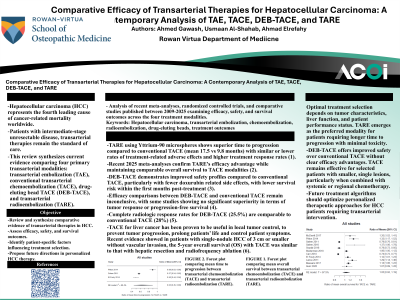
Results/Discussion: Current evidence demonstrates distinct advantages for different transarterial therapies. TARE with Yttrium-90 microspheres shows superior time to progression versus conventional TACE (mean 17.5 vs 9.8 months), with similar or lower adverse effects and higher response rates (1). 2025 meta-analyses confirm TARE’s efficacy advantage and comparable overall survival to TACE (2). DEB-TACE has improved safety versus conventional TACE, with fewer doxorubicin-related side effects and lower early post-treatment mortality (3). However, efficacy comparisons between DEB-TACE and conventional TACE remain inconclusive; tumor response and progression-free survival are similar (4). Radiologic complete response rates for DEB-TACE (25.5%) and conventional TACE (28%) are comparable (5). TACE remains effective for local control, symptom management, and survival prolongation in selected patients. Recent data show 5-year overall survival with TACE is similar to hepatic resection and radiofrequency ablation in single-nodule HCC ≤3 cm without vascular invasion (6).
Conclusions: Optimal treatment depends on tumor burden, liver function, and performance status. TARE is preferred for patients needing a longer time to progression with minimal toxicity. DEB-TACE improves safety over conventional TACE but offers no clear efficacy benefit. TACE remains valuable for small, single lesions, especially when paired with systemic or regional therapies. Future strategies should focus on personalizing transarterial interventions for HCC.