Osteopathic Medical Student Lake Erie College of Osteopathic Medicine Bradenton Bradenton, Florida, United States
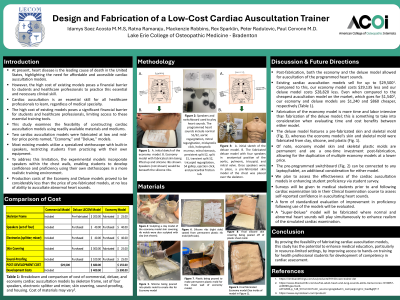
Introduction/Background: Cardiac auscultation is an essential skill for all healthcare professionals to learn, regardless of medical specialty. At present, heart disease is the leading cause of death in the United States, highlighting the need for affordable and accessible cardiac auscultation models. However, the high cost of existing models poses a significant financial barrier for students and healthcare professionals, limiting access to these essential training tools. This constraint hinders the development of critical diagnostic skills, potentially affecting the quality of patient care. This study examines the feasibility of constructing cardiac auscultation models using readily available materials and mediums.
Methods: Two cardiac auscultation models were developed at low and mid-tier price points: "Economy” and “Deluxe.” Most existing models utilize a specialized stethoscope with built-in speakers, restricting students from practicing with their own equipment. To address this, the experimental models incorporate speakers within the chest walls, enabling students to develop confidence and proficiency using their own stethoscopes in a more realistic training environment. The programmed heart sounds include normal S1/S2, aortic regurgitation, mitral regurgitation, midsystolic click, holosystolic murmur, mitral stenosis, persistent split S2, split S1, transient split S2, tricuspid regurgitation, S4 gallop, ejection click, and pericardial friction rub.
Results/Discussion: Post-fabrication, both models successfully allowed for auscultation of the programmed heart sounds. Existing cardiac auscultation models sell for up to $29,500. Compared to this, our economy model costs $29,135 less, and our deluxe model costs $28,820 less. Fabrication of the economy model is more time and labor-intensive than fabrication of the deluxe model; this is something to consider when evaluating the time and cost benefits between either model.
Conclusions: By proving the feasibility of fabricating cardiac auscultation models, this study has the potential to enhance medical education, particularly in resource-limited settings, by improving access to hands-on training for health professional students for development of competency in cardiac assessment.