Internal and Emergency Medicine Jefferson Health Northeast PHILADELPHIA, Pennsylvania, United States
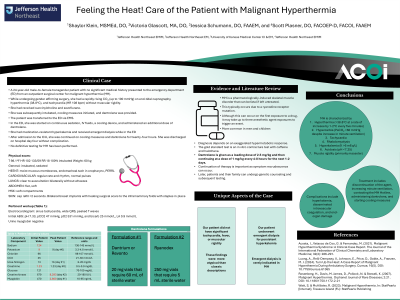
Clinical Scenario or Case: A 24-year-old MTF transgender patient with no significant history presented to the ED from an outpatient center for malignant hyperthermia. While undergoing gender affirming surgery, she had a rapidly rising CO2, hyperthermia, and tachycardia without muscular rigidity. She had received succinylcholine and sevoflurane. She was subsequently intubated, cooling measures started, and given dantrolene. In the ED, she was started on continuous sedation, IV fluids, a cooling device, and administered an additional dose of Dantrolene. She had medication-resistant hyperkalemia and received emergent dialysis. While in the ICU, she was continued on cooling measures and dantrolene for 24 hours. She was discharged on hospital day #4 without complication. No definitive testing for MH has been performed.
Evidence/Literature Review: MH is a pharmacologically-induced skeletal muscle disorder that can be fatal if left untreated. This typically occurs due to a ryanodine receptor mutation. Although this can occur on the first exposure to a drug, it may take up to three anesthetic agent exposures to trigger an event. Diagnosis depends on an exaggerated hypermetabolic response. The gold standard test is an in vitro contracture test with caffeine and halothane. Dantrolene is given as a loading dose of 2.5 mg/kg and then continuing at a dose of 1 mg/kg every 4-8 hours for the next 1-2 days. Continuation of therapy is important as symptom recrudescence can occur. Later, patients and their family can undergo genetic counseling and subsequent testing.
Unique Aspects of Case: Our patient did not have significant tachycardia, fever, or muscular rigidity. Our patient underwent emergent dialysis for persistent hyperkalemia.
Recommendations/Conclusions: MH is characterized by hyperthermia, hypercarbia, tachycardia, rhabdomyolysis, hyperkalemia, and muscle rigidity. Treatment includes discontinuation of the agent, increasing minute ventilation, contacting the MH Hotline, administering Dantrolene, and starting cooling measures. Complications include hyperkalemia, DIC, and end-organ damage.