Internal Medicine St. Luke's University Hospital Nazareth, Pennsylvania, United States
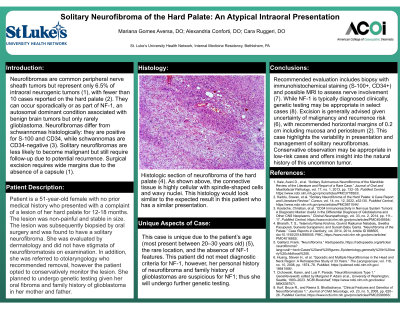
Clinical Scenario or Case: A 51-year-old female with no significant medical history presented with a stable, non-painful lesion of the hard palate for 12–18 months. Biopsy revealed a solitary neurofibroma. Dermatologic evaluation showed no stigmata of neurofibromatosis. Otolaryngology recommended excision, but the patient chose conservative monitoring. Given a family history of glioblastoma in both parents, she planned to undergo genetic testing.
Evidence/Literature Review: Neurofibromas are common peripheral nerve sheath tumors but represent only 6.5% of intraoral neurogenic tumors (1), with fewer than 10 cases reported on the hard palate (2). They can occur sporadically or as part of NF-1, an autosomal dominant condition associated with benign brain tumors but only rarely glioblastoma. Neurofibromas differ from schwannomas histologically: they are positive for S-100 and CD34, while schwannomas are CD34-negative (3). Solitary neurofibromas are less likely to become malignant but still require follow-up due to potential recurrence. Surgical excision requires wide margins due to the absence of a capsule (1).
Unique Aspects of Case: This case is unique due to the patient’s age (most present between 20–30 years old) (4), the rare location, and the absence of NF-1 features. Despite not meeting NF-1 criteria, her family history raises concern for a genetic predisposition.
Recommendations/Conclusions: Recommended evaluation includes biopsy with immunohistochemical staining (S-100+, CD34+) and possible MRI to assess nerve involvement (6). While NF-1 is typically diagnosed clinically, genetic testing may be appropriate in select cases (7). Excision is generally advised given uncertainty of malignancy and recurrence risk (5), with recommended horizontal margins of 0.2 cm including mucosa and periosteum (2). This case highlights the variability in presentation and management of solitary neurofibromas. Conservative observation may be appropriate in low-risk cases and offers insight into the natural history of this uncommon tumor.