Internal Medicine / Emergency Medicine Aria Jefferson Health - - Philadelphia, PA Philadelphia, Pennsylvania, United States
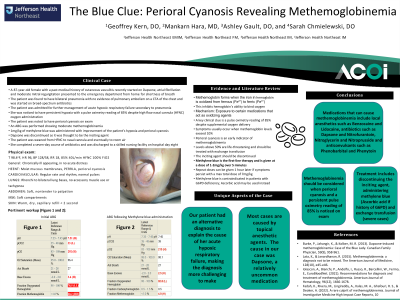
Clinical Scenario or Case: An 87-year-old female with cutaneous vasculitis recently started on dapsone, bullous pemphigoid, lung cancer on Tagrisso, and breast cancer on anastrozole was admitted with acute hypoxic respiratory failure due to pneumonia. She required high supplemental oxygen and was found to have methemoglobinemia, likely from dapsone. The patient was treated with methylene blue, resulting in significant improvement of her hypoxia.
Evidence/Literature Review: Methemoglobinemia is a condition where red blood cells contain elevated levels of methemoglobin—typically above 1% of total hemoglobin. Methemoglobin forms when the iron in hemoglobin is oxidized from ferrous (Fe²⁺) to ferric (Fe³⁺), which cannot bind oxygen, leading to functional hypoxia. It is often acquired through exposure to oxidizing agents such as certain drugs or local anesthetics. A key clinical clue is that oxygen saturation hovers around 85–90%, even when the patient is on 100% oxygen. Symptoms usually appear when methemoglobin exceeds 10%, with cyanosis as an early sign. Between 20–50%, patients may experience fatigue, anxiety, dizziness, and tachycardia. Levels above 50% are life-threatening and may result in severe hypoxia or death. Treatment depends on severity. Methylene blue is first-line therapy but is contraindicated in G6PD deficiency; ascorbic acid may be used instead.
Unique Aspects of Case: The patient presented with hypoxia initially misattributed to pneumonia and was misdiagnosed in the emergency department. Despite 15 liters of supplemental oxygen, her saturation remained at 86%, though she normally required none. Persistent perioral cyanosis prompted further evaluation. Arterial blood gas showed chocolate-brown blood and a methemoglobin level of 29%, confirming methemoglobinemia.
Recommendations/Conclusions: Dapsone is an oral medication used to treat some cutaneous vasculitis by altering neutrophil function. It also acts as an oxidizing agent, converting hemoglobin iron from ferrous (Fe²⁺) to ferric (Fe³⁺), impairing oxygen delivery. In this case, dapsone was the likely cause of the patient’s hypoxia and methemoglobinemia.