Internal Medicine Kettering Health Dayton, Ohio, United States
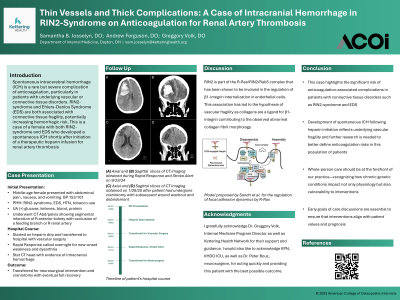
Clinical Scenario or Case: This is a case presentation of a middle-aged female with history of genetically confirmed RIN2 syndrome and EDS who presented to the emergency department with abdominal pain, nausea, and vomiting. CT Imaging was significant for renal artery thrombosis, for which the patient was initiated on a heparin infusion. Within 24 hours of initiation of anticoagulation, the patient developed a spontaneous intracranial hemorrhage with no preceding trauma. Imaging confirmed a large right frontal hematoma, surrounding edema, associated mass effect and midline shift. The patient required intensive neurocritical care with subsequent craniotomy, but ultimately made a remarkable recovery.
Evidence/Literature Review: RIN2-syndrome is a rare connective tissue disorder with phenotypic overlap of Ehlers-Danlos Syndrome (EDS). These conditions predispose patients to vascular fragility and complications. Anticoagulation in such patients poses a heightened risk for bleeding events, yet may be clinically necessary in the setting of thromboembolism. There is limited literature in association with RIN2-syndrome and anticoagulation. On reviewing pathophysiology of RIN2, R-Ras/RIN2/Rab5 complex has been shown to be involved in the regulation of β1-integrin internalization in endothelial cells, which leads to the hypothesis of vascular fragility as collagens are a ligand for β1-integrin contributing to the observed abnormal collagen fibril morphology (Rosato et al.).
Unique Aspects of Case: Per Rosato et al, as of 2016, there were only nine patients from four independent families diagnosed with RIN2-Syndrome (previously known as MACS - Macrocephaly, alopecia, cutis laxa, scoliosis). No current research has suggested that these patients are also hypercoagulable alongside their vascular fragility.
Recommendations/Conclusions: This case highlights the delicate balance of anticoagulation in patients with vascular fragility from connective tissue disorders like RIN2-syndrome. It emphasizes whole-person care, acknowledging how chronic genetic conditions affect both physiology and intervention risk. Furthermore, the utilization of anticoagulation in patients with known vascular fragility disorders, as in RIN2-syndrome, is an area of research for future consideration.