Internal Medicine Sky Ridge Medical Center HCA HealthONE Denver, Colorado, United States
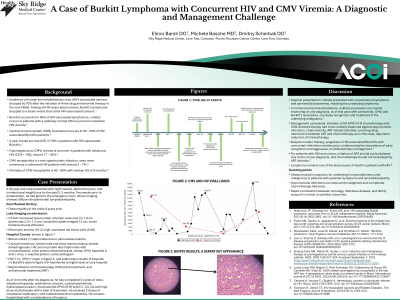
Clinical Scenario or Case: A 50-year-old male presented with fatigue, night sweats, and weight loss. Imaging revealed diffuse lymphadenopathy, and workup identified Salmonella bacteremia and CMV viremia. Lymph node biopsy confirmed Burkitt’s lymphoma with 30% bone marrow involvement and CSF positivity. Concurrently, he was diagnosed with HIV (CD4 count 32, high viral load). He was rapidly initiated on dose-adjusted EPOCH-R and intrathecal methotrexate alongside antiretroviral therapy. His treatment course was complicated by enterococcus bacteremia, pancytopenia, protein-calorie malnutrition, pneumonia, pulmonary embolism, and EBV reactivation.
Evidence/Literature Review: Burkitt’s lymphoma is an aggressive B-cell non-Hodgkin lymphoma with an immunodeficiency-associated subtype commonly seen in HIV. This variant has a higher risk of CNS and bone marrow involvement. While ART has reduced HIV-associated malignancies, Salmonella bacteremia and CMV viremia remain prevalent in advanced or uncontrolled HIV. Notably, Burkitt’s lymphoma can occur even with relatively preserved CD4 counts, highlighting the complex interplay between immune status and oncogenesis that complicates diagnosis and management.
Unique Aspects of Case: We present a rare case of newly diagnosed HIV with concurrent stage IV Burkitt’s lymphoma, CMV viremia, and Salmonella bacteremia. This triad of AIDS-defining illnesses highlights the complexity of managing aggressive malignancy and opportunistic infections in a severely immunocompromised patient. Urgent initiation of ART and chemotherapy is challenged by overlapping toxicities and drug interactions. To our knowledge, this is the first reported case of this combination, emphasizing the need for careful coordination of care in advanced HIV with multiple coexisting complications.
Recommendations/Conclusions: This case illustrates the complex interplay of Burkitt’s lymphoma, newly diagnosed HIV, CMV viremia, and Salmonella bacteremia in a severely immunocompromised patient. Successful management required a multidisciplinary approach with early subspecialty involvement and escalation of care. It emphasizes the need for a high index of suspicion for malignancy in immunocompromised patients and, conversely, the importance of HIV testing in individuals presenting with aggressive new-onset lymphomas.