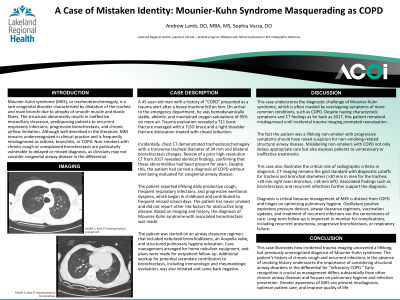
Clinical Scenario or Case: A 45-year-old man with a history of “COPD” presented as a trauma alert after being struck by a heavy machine. He was hemodynamically stable and maintained oxygen saturation of 95% on room air. A burst fracture of T11 was identified. Incidentally, chest CT revealed marked tracheal dilatation (34 mm transverse diameter), bilateral main bronchial enlargement, upper lobe bullous changes, and scattered bronchiectasis. Pulmonary consultation led to a diagnosis of MKS based on imaging and clinical history. The patient, a lifelong non-smoker, endorsed a longstanding history of productive cough, recurrent respiratory infections, and missed school days in childhood—symptoms never previously linked to structural airway disease. He was started on airway clearance therapy with an Aerobika device, nebulized bronchodilators, and pulmonary hygiene education.
Evidence/Literature Review: Mounier-Kuhn syndrome (MKS), or tracheobronchomegaly, is a rare congenital disorder characterized by dilatation of the trachea and main bronchi due to atrophy of elastic and smooth muscle fibers. It is often underrecognized, particularly in non-smoking patients misdiagnosed with asthma, bronchitis, or COPD. Diagnosis is radiographic and typically delayed until advanced disease or incidental imaging reveals characteristic findings.
Unique Aspects of Case: This case highlights the diagnostic challenge of MKS and the need for heightened clinical suspicion in non-smokers with unexplained bronchiectasis, recurrent infections, or refractory “COPD.” Tracheobronchomegaly is often mistaken for sequelae of smoking-related disease but requires distinct management, including aggressive pulmonary hygiene and monitoring for complications such as recurrent pneumonia, airway collapse, and respiratory failure.
Recommendations/Conclusions: Trauma imaging led to the unexpected diagnosis in this patient, illustrating how incidental findings may uncover rare, lifelong pulmonary disease. Awareness of MKS is critical to prevent mismanagement and improve quality of life through targeted care.