Internal Medicine Laredo Medical Center Laredo, Texas, United States
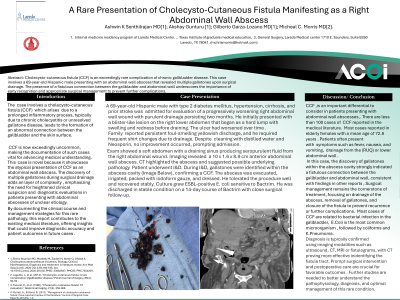
Clinical Scenario or Case: A 69-year-old Hispanic male with a history of type 2 diabetes mellitus, hypertension, cirrhosis, and prior stroke presented to the hospital for evaluation of a progressively worsening right abdominal wall wound with purulent drainage persisting for two months. In October 2024, the patient initially presented to the clinic with a blister-like lesion on the right lower abdomen. Two months later, in December 2024, the patient returned to the clinic with worsening of the ulcer on the right lower abdomen. His wife reported persistent suppurative yellowish discharge that was foul-smelling, On examination, a draining sinus emitting seropurulent fluid from a right-sided abdominal wound is seen. Imaging with CT abdomen shows a abscess in the right anterior abdominal wall. CT imaging played a significant role in identifying the abscess and suggested a possible fistulous connection. Patient underwent incision and drainage (I&D) during which gallstones were found within the abscess cavity, confirming the presence of a cholecysto-cutaneous fistula. Culture of the discharge grew ESBL Ecoli and the patient was discharged on Bactrim for 14 days.
Evidence/Literature Review: Cholecysto-cutaneous fistula is a rare complication arising from chronic gallbladder disease, with less than 100 cases reported. Historically common, CCF occurs due to prolonged inflammation, often presenting atypically, as seen in this case of an abdominal wall abscess with gallstones. Early recognition and surgical management are crucial for optimal outcomes.
Unique Aspects of Case: exceedingly rare complication. Hispanic male.
Recommendations/Conclusions: Diagnosis is typically confirmed using imaging modalities such as ultrasound, computed tomography, magnetic resonance imaging, or fistulograms, with CT proving more effective in identifying the fistula tract and associated collections. Prompt surgical intervention and postoperative care are crucial for favorable outcomes. Further studies are needed to better understand the pathophysiology, diagnosis, and optimal management of this rare condition.