Geriatric Medicine Cleveland Clinic/ Cleveland Clinic Lerner College of Medicine Cleveland Heights, Ohio, United States
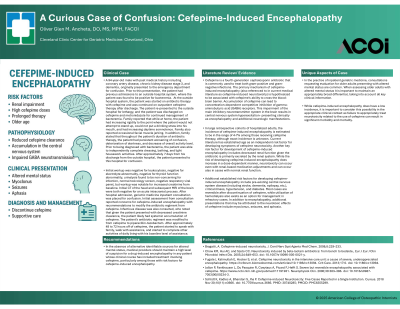
Clinical Scenario or Case: A 94 year old male presented for confusion. At an outside hospital system, the patient was bacteremic and started on cefepime with continued outpatient therapy. While home, the patient had increasing rigidity where he could not stand up, could not use a drinking straw, and had increasing daytime somnolence. Family also reported facial muscle jerking. At baseline, the patient was independent with dressing, bathing, and light housework.
Geriatric medicine inpatient consultation was requested for confusion, with initial assessment of concerns for cefepime-induced encephalopathy and recommendations to modify antibiotic regiment from cefepime. Infectious disease was consulted, who noted the patient likely had systemic cefepime accumulation. The antibiotic regiment was modified from cefepime to piperacillin-tazobactam. After approximately 72 hours off cefepime, the patient started to speak with family and complete activities with baseline level of assistance.
Evidence/Literature Review: A fourth-generation cephalosporin antibiotic, cefepime is widely used in gram-positive and gram-negative infections. The mechanism of cefepime-induced encephalopathy (also referred to as cefepime-induced neurotoxicity) is thought to be associated with cefepime’s ability to cross the blood-brain barrier. Accumulation can lead to competitive inhibition of gamma-aminobutyric acid (GABA) receptors, resulting in neurologic manifestations.
The incidence of cefepime-induced encephalopathy is estimated to be 4-7%, although exact incidence is unknown. Age and decreased renal function are independent risk factors for cefepime neurotoxicity. Most cases are reversible after antibiotic discontinuation, while hemodialysis exists as a management option. Additional presentations attributable to cefepime may include aphasia, myoclonus, and seizures.
Unique Aspects of Case: In the practice of geriatric medicine, consultations for altered mental status are common. While cefepime-induced encephalopathy has a low incidence, it is important to consider this possibility in the appropriate clinical context.
Recommendations/Conclusions: In cases of altered mental status, medical providers should maintain a high level of suspicion for a drug-induced encephalopathy in any patient whose clinical course has included treatment involving cefepime.