N/A Alabama College of Osteopathic Medicine Tavernier, Florida, United States
Introduction/Background: Chronic pain is a prevalent and multifaceted condition affecting people living with HIV and may be influenced by Highly Active Antiretroviral Therapy (HAART). This study analyzed the relationship between self-reported pain severity and specific antiretroviral drug regimens to evaluate potential associations between HAART and chronic pain.
Methods: A total of 113 patients were screened through a phone survey, and data on pain severity (rated from 0 to 5) and HAART prescriptions—including nucleoside reverse transcriptase inhibitors (NRTIs), integrase strand transfer inhibitors (INSTIs), non-nucleoside reverse transcriptase inhibitors (NNRTIs), and protease inhibitors (PIs)—were collected.
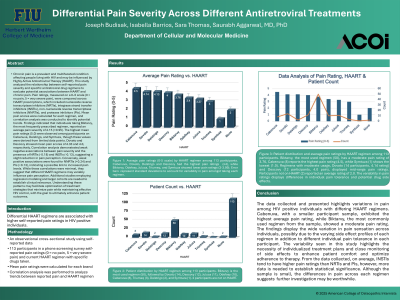
Results/Discussion: Findings indicated that individuals taking Biktarvy, the most frequently prescribed regimen, reported an average pain severity of 4.15 (±0.95). The highest mean pain ratings (5.0) were observed among patients on Cabenuva, Delstrigo, and Symtuza, though these values were derived from limited data points. Dovato and Descovy showed mean pain scores of 4.33 and 4.0, respectively. Correlation analysis demonstrated weak negative associations between pain severity and the presence of NRTIs (-0.18) and INSTIs (-0.13), suggesting a slight reduction in pain perception. Conversely, weak positive associations were found for NNRTIs (+0.24) and PIs (+0.13), indicating a possible link to increased pain levels.
Conclusions: While these correlations were minimal, they suggest that different HAART regimens may variably influence pain perception. Additional studies employing regression modeling and larger cohorts are needed to establish clinical relevance. Understanding these patterns may facilitate optimization of treatment strategies that minimize pain while maintaining effective HIV control, ultimately enhancing patient outcomes.