Internal Medicine Santa Clara Valley Medical Center Campbell, California, United States
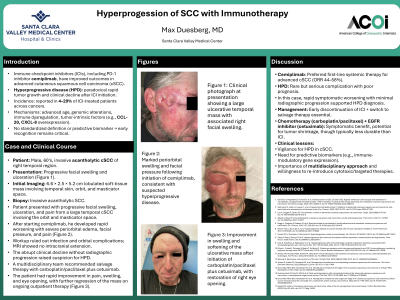
Clinical Scenario or Case: We report the case of a man in his 60s with invasive acantholytic cutaneous squamous cell carcinoma (cSCC) of the right temporal region who developed rapid periorbital swelling and pain shortly after initiating cemiplimab. Imaging ruled out orbital or intracranial extension, and infectious workup was negative. Given the rapid clinical deterioration without radiographic or microbiologic evidence of infection, hyperprogressive disease (HPD) was suspected. A multidisciplinary team recommended discontinuation of immunotherapy. The patient was subsequently treated with systemic chemotherapy (carboplatin and paclitaxel) and cetuximab, leading to significant symptomatic improvement and tumor regression.
Evidence/Literature Review: HPD occurs in 4–29% of patients treated with immune checkpoint inhibitors across cancers, but remains poorly characterized in cSCC. Emerging data suggest associations with age, tumor-intrinsic factors, and cytokine dysregulation (e.g., CCL-20, CXCL-8). No validated biomarkers or diagnostic criteria exist. While cemiplimab is effective in advanced cSCC, rapid clinical worsening post-initiation should raise suspicion for HPD and prompt urgent treatment reassessment.
Unique Aspects of Case: This case highlights a rare presentation of HPD following PD-1 blockade with cemiplimab in advanced acantholytic cSCC. The patient developed rapid periorbital swelling and clinical decline within weeks, despite minimal radiographic progression and no infection. Early recognition of HPD and a prompt switch to salvage chemotherapy plus EGFR inhibition led to rapid symptomatic improvement. This case emphasizes the need for vigilance in identifying HPD in cSCC and suggests a role for cytotoxic therapy even after immunotherapy failure.
Recommendations/Conclusions: Clinicians should maintain a high index of suspicion for HPD in cSCC patients who rapidly deteriorate after starting immunotherapy. Early recognition and multidisciplinary evaluation are critical to avoid delays in effective salvage therapy. Cytotoxic chemotherapy and EGFR inhibition remain viable options in immunotherapy-refractory cases. Further research is needed to define predictive biomarkers, standardize HPD criteria, and guide treatment decisions in advanced cSCC.