(4) High Subconscious Connectedness is Associated with Greater Use, More Favorable Experience, and Higher Expectations of Complementary Health Approaches in the U.S. Adult Population
Internal Medicine and Osteopathic Manipulative Medicine Campbell University Buies Creek, North Carolina, United States
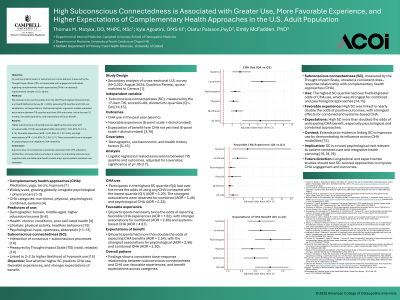
Background: Subconscious cognitive patterns may be critical in shaping engagement with complementary health approaches (CHA). However, little is known about how subconscious connectedness influences CHA use, satisfaction, and expectations. This study examined whether levels of subconscious connectedness, measured by the Thought Impact Scale (TIS), are associated with engagement and beliefs regarding CHA in a nationally representative sample of U.S. adults.
Methods: We analyzed secondary data from the 2024 Psychological Characteristics and Health Behaviors Survey (N = 3,022), including the TIS and CHA use measures, satisfaction, and expectations. Multivariate logistic regression models evaluated associations between TIS quartiles and three CHA engagement outcomes: use in the past 12 months, favorable experience, and expectations of future benefit.
Results: Higher levels of subconscious connectedness were significantly associated with increased odds of CHA use (adjusted odds ratio [aOR] = 3.62, 95% CI: 2.14- 6.14), favorable experience (aOR = 2.20, 95% CI: 1.32-3.68), and high expectations (aOR = 2.54, 95% CI: 2.00-3.21).
Conclusions: Subconscious connectedness is positively associated with CHA utilization, satisfaction, and expectations among U.S. adults. These findings support the inclusion of subconscious cognitive traits in behavioral health models and suggest opportunities for improving patient-centered care strategies through cognitive profiling.