Internal Medicine Johns Hopkins School of Medicine Hanover, Maryland, United States
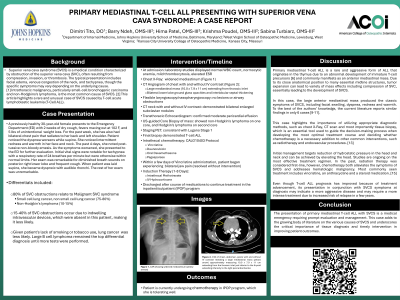
Clinical Scenario or Case: Superior vena cava syndrome (SVCS) is a rare but serious condition typically associated with malignancy. While lung cancer and lymphoma are common causes, less frequent etiologies can present a diagnostic challenge. We report a case of a young adult female who presented with classical symptoms of SVCS, including facial edema, neck vein distention, and dyspnea. Diagnostic workup revealed a large mediastinal mass, which was subsequently confirmed as T-cell acute lymphoblastic leukemia (T-ALL) on biopsy.
Evidence/Literature Review: Non-small-cell lung cancer (NSCLC) is the most common malignant cause of Superior vena cava syndrome (SVCS), followed by small-cell lung cancer (50% and 25%, respectively), with lymphomas accounting for about 10% of cases. However, T-cell acute lymphoblastic leukemia (T-ALL) is a less common underlying cause. To the best of the author knowledge, only 6 cases of confirmed T-ALL presenting with SVCS have been reported in the literature. One study grouped T-ALL and T-cell lymphoblastic lymphoma (T-LBL) cases together, reporting 11 cases with SVCS.
Unique Aspects of Case: This case highlights the importance of considering T-ALL in the differential diagnosis of SVCS, particularly in younger individuals without traditional risk factors. Early recognition and prompt initiation of appropriate therapy, including chemotherapy and potentially radiation therapy, are crucial for optimal patient outcomes.
Recommendations/Conclusions: The presentation of primary mediastinal T-ALL with SVCS is a medical emergency requiring prompt evaluation and management. This case underscores the need for a high index of suspicion for rare malignancies, even in the context of common presentations.