Medical Student Campbell University School of Osteopathic Medicine Durham, North Carolina, United States
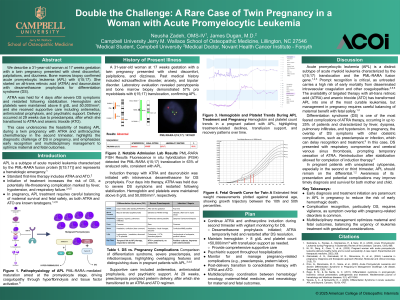
Clinical Scenario or Case: A 31-year-old woman at 17 weeks gestation with a twin pregnancy presented with chest discomfort, palpitations, and dizziness. Bone marrow biopsy confirmed acute promyelocytic leukemia (APL) with 57% promyeloblasts and the t(15;17) translocation. Induction therapy with all-trans retinoic acid (ATRA) and daunorubicin was initiated alongside IV dexamethasone for differentiation syndrome (DS) prophylaxis. Hemoglobin and platelet counts were aggressively maintained above 8 g/dL and 50,000/mm³. ATRA was temporarily held due to severe DS symptoms and restarted once the patient stabilized. She received comprehensive care and psychiatric support until delivery at 29 weeks due to preeclampsia.
Evidence/Literature Review: APL, a subtype of acute myeloid leukemia defined by the PML-RARA fusion protein [t(15;17)], is a hematologic emergency requiring immediate therapy. The standard first-line regimen includes ATRA and arsenic trioxide (ATO). Current literature supports cautious use of ATRA during the second and third trimesters, often with an anthracycline. Treatment initiation increases the risk of DS, a potentially fatal complication resulting from rapid leukemic cell maturation, leading to fever, hypotension, and respiratory failure. In pregnancy, therapy requires careful balancing of maternal and fetal risks, particularly with teratogenic agents.
Unique Aspects of Case: Our regimen proved effective in achieving disease control without fetal loss or developmental complications. The development of DS complicated therapy, but early recognition and prompt management allowed for symptom resolution and re-initiation of ATRA. DS symptoms can mimic more common pregnancy-related conditions such as preeclampsia, thromboembolic events, and infections - thus highlighting the diagnostic challenge in this population.
Recommendations/Conclusions: APL in pregnancy, especially with twin gestations, presents a rare and complex therapeutic dilemma. Teratogenicity concerns restrict ATO use. This case illustrates the feasibility of ATRA and anthracycline chemotherapy in a twin pregnancy when managed by a multidisciplinary team. Early DS recognition and intervention are critical to maintaining treatment and achieving favorable maternal and fetal outcomes.