OMS - III VCOM - Carolinas valrico, Florida, United States
Introduction/Background: Ultrasound curricula have become more common in undergraduate medical education in recent years. However, there is variation in the curriculum design, composition, and implementation process. Few studies have tested students' hands-on skills proficiency after completing a curriculum. This study aims to evaluate a self-directed ultrasound curriculum to increase undergraduate medical students' knowledge and proficiency in ultrasound techniques.
Methods: The population pool included second-year students from the VCOM - Carolinas Campus. Thirty-nine second-year medical students voluntarily participated in the study during three separate four-week sessions. Each student was assigned a Butterfly ultrasound probe, instructed to watch fifty Butterfly iQ training videos, and asked to practice the ultrasound skills throughout the four weeks. Students were encouraged to attend a two-hour training session with a sonographer two weeks before the assessment day. At the end of the four weeks, a sonographer used a skills checklist to grade each student’s ultrasound technique and record their measurements of a breast mass and crown-rump length.
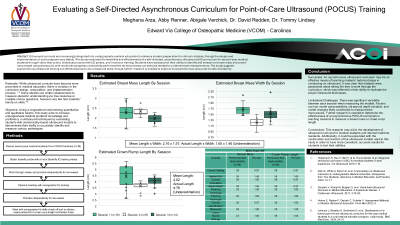
Results/Discussion: The length and width of the breast mass were 2.65 x 1.46 cm. The overall mean of participant measurements was 2.16 x 1.57 cm, which is considered an underestimation. The crown-rump length measured 4.76 cm. The overall mean of participant measurements was 4.02 cm, which was also an underestimation. Between the breast model and crown-rump length model, the majority of participants were able to correctly perform key steps while using the ultrasound at a 100% success rate. The steps that had a 97% success rate were picking the correct ultrasound setting, identifying the mass/fetus, choosing the appropriate orientation, and adjusting depth.
Conclusions: An asynchronous ultrasound curriculum may be an effective means of teaching students technical steps in conducting an ultrasound. This research may aid in the development of ultrasound curricula for medical students and internal medicine residents.