Introduction/Background: Depression and loneliness are each linked to cardiovascular disease (CVD), but few studies have examined their combined impact. The American Heart Association recently identified loneliness as an independent CVD risk factor, while depression is tied to higher ASCVD risk, typically measured using the ACC ASCVD calculator and PHQ-9. This study explored how UCLA Loneliness Scale and PHQ-9 scores relate to ASCVD risk in adults at a free clinic in Upstate South Carolina.
Methods: Thirty-one English-speaking patients ages 20–79 with a lipid panel within the past year were recruited. Participants completed the PHQ-9, UCLA Loneliness Scale, and a brief health survey before or after their visit. ASCVD 10-year and lifetime risks were calculated using the ACC calculator. Data were de-identified and analyzed in Excel for correlations and multiple linear regressions.
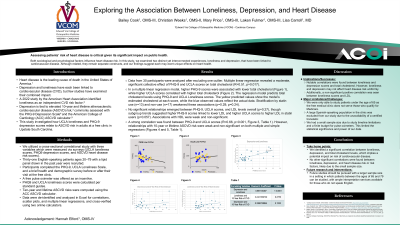
Results/Discussion: Data from 30 participants were analyzed after excluding one outlier. A multiple linear regression showed a moderate, significant combined effect of PHQ-9 and UCLA scores on total cholesterol (R=0.51, p=0.017). Higher PHQ-9 scores were linked to lower total cholesterol, while higher UCLA scores correlated with higher total cholesterol. Stratifying by statin use weakened these associations (p>0.24).
No significant relationships were found between PHQ-9, UCLA scores, and LDL or HDL overall, though trends suggested higher PHQ-9 scores linked to lower LDL and higher UCLA scores to higher LDL among statin users (p=0.057). A strong correlation was observed between PHQ-9 and UCLA scores (R=0.66, p< 0.001). However, associations with ASCVD 10-year and lifetime risk were weak and non-significant.
Conclusions: While no significant links were found between PHQ-9 or UCLA scores and ASCVD risk, likely due to small sample size, we observed a notable association with total cholesterol. Depression and loneliness, though related, may differently impact cardiovascular health and should not be viewed as interchangeable risk markers. Larger studies are warranted to clarify these relationships.