Internal Medicine West Virginia School of Osteopathic Medicine Holmdel, New Jersey, United States
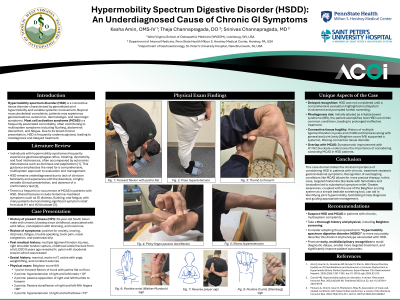
Clinical Scenario or Case: We present a 29-year-old male with longstanding GI symptoms of acid reflux, bloating, and constipation, initially diagnosed as IBS. Further evaluation revealed multisystem symptoms including insomnia, anxiety, nasal congestion, and back pain. His history of ligament tears and fractures indicated connective tissue fragility. Physical exam showed generalized joint laxity (Beighton score 9/9), consistent with hypermobility spectrum disorder (HSD). Suspected mast cell activation syndrome (MCAS) was treated empirically with H1 and H2 blockers, resulting in significant improvement. The diagnosis of HSD with associated MCAS explained his symptoms and informed targeted therapy.
Evidence/Literature Review: Recent literature highlights a strong link between HSD and gastrointestinal, autonomic, and immune dysfunction. A 2025 AGA Clinical Practice Update reports symptoms such as reflux, bloating, dysmotility, and dizziness in individuals with HSD. Carroll (2023) highlights that HSD remains underdiagnosed due to variable presentations and limited clinician familiarity, calling for increased awareness. A 2022 review by Monaco et al. underscores the frequent co-occurrence of MCAS in patients with HSD, with symptomatic improvement seen after H1 and H2 blockade. Together, these sources reinforce the need for early, multidisciplinary recognition to improve outcomes.
Unique Aspects of Case: This case illustrates delayed recognition of HSD despite chronic GI symptoms. Multisystem complaints were misattributed to stress, while joint hypermobility went unnoticed. HSD’s systemic symptoms often mimic IBS and chronic fatigue syndrome, leading to diagnostic delays. The patient’s improvement with H1 and H2 blockers highlighted coexisting MCAS emphasizing the need to consider this syndrome in unexplained multisystem cases.
Recommendations/Conclusions: HSD often mimics IBS, causing frequent misdiagnosis. The Beighton score is a simple bedside tool for early diagnosis and referral. Coexisting MCAS should be considered, as treatment with H1 and H2 blockers can provide relief. We propose the term “hypermobility spectrum digestive disorder (HSDD)” to better describe this GI presentation. Early recognition enables targeted treatment and improves quality of life.