OMS III Kansas City University Hackensack, New Jersey, United States
Introduction/Background: Obstructive sleep apnea (OSA) and chronic obstructive pulmonary disease (COPD) frequently coexist (1 in 10 individuals with 1 condition will also have the other disorder), forming Overlap Syndrome (OVS), a condition associated with worse health outcomes and increased mortality compared to either disease alone. However, the impact of OVS on inpatient hospitalization remains unclear. This study evaluates the clinical characteristics of OVS and its association with inpatient admissions.
Methods: Data were obtained from the Healthcare Enterprise Repository for Ontological Narration (HERON) at the University of Kansas Health System for patients undergoing diagnostic sleep studies from 2012 to 2021. Patients with available apnea-hypopnea index (AHI) and forced expiratory volume/forced vital capacity (FEV1/FVC) data were included in the analysis.
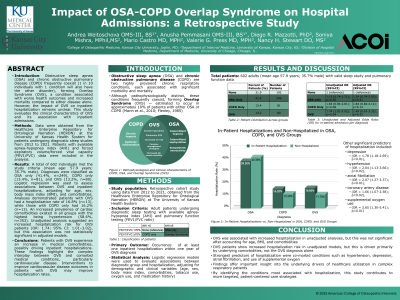
Results/Discussion: A total of 602 individuals met the study criteria (mean age: 57.9 years; 35.7% male). Diagnoses were classified as OSA only (41.4%, n=249), COPD only (13.4%, n=81), and OVS (13.2%, n=80). Logistic regression was used to assess associations between OVS and inpatient hospitalizations, adjusting for age, sex, body mass index (BMI), and comorbidities. Analyses demonstrated patients with OVS had a hospitalization rate of 16.8% (n=13), while those with COPD only had 16.2% (n=13). An increased prevalence of cardiac comorbidities existed in all groups with the highest being hypertension (58.6%, n=353). Unadjusted analysis suggested an increased hospitalization risk for OVS patients (OR: 1.74; 95% CI: 1.01–3.02), but this association was not statistically significant in adjusted models.
Conclusions: Patients with OVS experience an increase in medical comorbidities, possibly driving inpatient hospitalizations. These findings highlight the complex interplay between OVS and comorbid medical conditions, particularly cardiovascular disease. Interventions to improve cardiovascular disease outcomes in patients with OVS may improve hospitalization rates.