Medical Student Dr. Kiran C. Patel College of Osteopathic Medicine at Nova Southeastern University Port Orange, Florida, United States
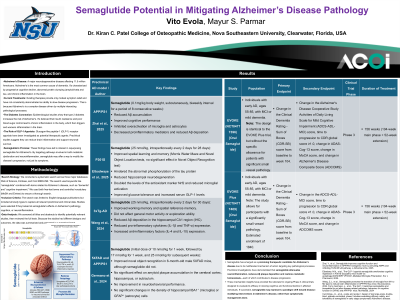
Introduction/Background: Alzheimer's disease (AD) is characterized by the accumulation of amyloid-beta (Aβ) plaques and neurofibrillary tangles composed of hyperphosphorylated tau protein. Tau pathology is strongly correlated with neurodegeneration and cognitive decline in AD. Current therapeutic strategies for AD remain limited, highlighting the urgent need for novel interventions that have a multifaceted therapeutic impact targeting various aspects of AD pathology. Semaglutide, a glucagon-like peptide-1 (GLP-1) receptor agonist, has demonstrated neuroprotective effects, such as reduction in Aβ pathology, in preclinical AD models. However, its specific role in mitigating tau pathology warrants further investigation. This study aims to evaluate the potential of Semaglutide to mitigate annonacin-induced tau pathology in LUHMES cells, an in vitro AD model.
Methods: LUHMES cells will be differentiated and then treated with annonacin to induce a 4R-tauopathy, characterized by increased tau phosphorylation and aggregation. Following annonacin treatment, cells will be treated with varying concentrations of Semaglutide. Tau pathology will be assessed using a combination of techniques, including Western blotting to quantify levels of total and hyperphosphorylated tau (e.g., AT8, PHF-1), immunofluorescence microscopy to visualize tau hyperphosphorylation, and viability assays to assess neuroprotection. Appropriate statistical analyses will be employed to determine significant differences between experimental groups.
Results/Discussion: We anticipate that annonacin treatment will induce significant tau pathology in LUHMES cells. Importantly, we hypothesize that treatment with Semaglutide will dose-dependently mitigate tau hyperphosphorylation. Furthermore, Semaglutide treatment may also improve cell viability in the presence of annonacin-induced stress.
Conclusions: Based on the expected outcomes, this study aims to demonstrate that Semaglutide can reduce tau pathology in a human neuronal cell model. These findings would offer more evidence supporting the potential therapeutic use of GLP-1 receptor agonists like Semaglutide for AD, especially targeting tau-related neurodegeneration. This research could lead to future in vivo studies.