Medical Student Midwestern University/CCOM Naperville, Illinois, United States
Introduction/Background: Oral squamous cell carcinoma (OSCC) s a common malignancy of the head and neck region and remains to have relatively low five-year survival rates. Preliminary recognition of OSCC remains challenging as many patients remain asymptomatic until there is advanced progression emphasizing the importance of earlier detection and diagnosis. Existing diagnosis of OSCC is based solely on histological morphology, subject to inter-oberservor variability. Serpin B5, a serine protease inhibitor with tumor suppressor functions, inhibits growth, invasion, and metastasis of malignant cells. However, previous studies have shown differing expression trends, and we aim to better understand the role of Serpin B5 in head and neck cancer.
Methods: Immunohistochemistry with specific antibodies of tissue microarray samples of normal and OSCC of variable histopathological and TNM status were done. Samples underwent high-resolution imaging and computer-assisted analysis with a positive-pixel-counting software. A histo-score was calculated based on the staining intensity and the percentage of positively stained cells in each sample to determine significance using statistical analysis.
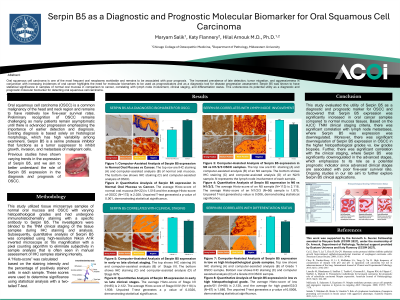
Results/Discussion: Serpin B5 expression had a significant decrease in OSCC samples in comparison to normal oral mucosa, suggesting its applicability as a clinical diagnostic tool. Expression was significantly downregulated in OSCC with high histopathological grades compared to samples with low grades. Advanced TNM stages (stages III and IV) OSCC samples showed significant differential expression compared to earlier stages (stages I and II). Consequently, correlating Serpin B5 expression to the critical prognostic indicators of histopathological grading/differentiation status and clinical staging of OSCC.
Conclusions: Significant differential expression between normal and cancer oral specimens was found, highlighting its role as a diagnostic biomarker. We have shown significant differences in Serpin B5 expression as it correlates with the histopathological grade and TNM clinical classification, emphasizing the potential prognostic capabilities of Serpin B5. Ongoing studies in our lab aim to further explore Serpin B5 clinical applications.