Medical Student Future Forwards Research Institute Stratford, New Jersey, United States
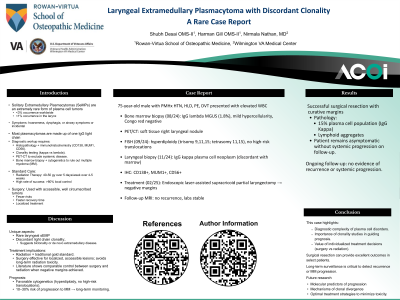
Clinical Scenario or Case: A 75-year-old male with a history of hypertension, hyperlipidemia, DVT, and PE presented with leukopenia post-hip replacement. Workup revealed an IgG lambda monoclonal protein, and bone marrow biopsy confirmed MGUS without CRAB features. Cytogenetics showed hyperdiploidy (trisomy 9, 11, 15; tetrasomy 11, 15) and absence of high-risk translocations. PET/CT revealed a right laryngeal nodule, and biopsy showed an IgG kappa plasma cell neoplasm variable from the bone marrow findings. The patient underwent endoscopic laser-assisted supracricoid partial laryngectomy with negative margins. Tumor biopsy revealed CD138+, MUM1+, and CD56+ plasma cells with possible marginal zone lymphoma. Follow-up imaging showed no recurrence.
Evidence/Literature Review: Solitary extramedullary plasmacytomas (sEMPs) comprise < 3% of plasma cell neoplasms, with < 1% involving the larynx. Most patients present with nonspecific symptoms like hoarseness, and these lesions may mimic other head and neck tumors. Radiation therapy remains standard, though surgical excision has shown comparable efficacy in selected patient. Additionally, variable light chain expression in MGUS with extramedullary involvement is extremely rare and may suggest biclonality or a different tumorigenesis.
Unique Aspects of Case: This case illustrates an unusual occurrence of laryngeal EMP in the setting of MGUS with distinct clonality, raising questions about clonal evolution. The novelty of MGUS with 2 different light chains differentiates this case from other sEMPS. Additionally, while the cytogenetic profile supports a favorable prognosis, the patient opted to have surgical management over radiation therapy which remains the gold standard. The success of the surgery can provide new insights and guidelines into treatment options.
Recommendations/Conclusions: This case underscores the diagnostic and therapeutic complexities of EMP in the larynx, particularly with discordant MGUS. It highlights surgery as a curative option in well-selected patients and emphasizes the need for vigilant long-term follow-up. Furthermore, additional studies are warranted to understand clonal divergence and optimize treatment strategies for the future.