Medical Student Rowan SOM South River, New Jersey, United States
Introduction/Background: Acute myeloid leukemia (AML) remains a challenging malignancy with 5-year survival rates under 30% in older adults. Despite advances in targeted therapy, key oncogenic drivers—especially transcription factors like MYC, RUNX1-ETO, and AML1-ETO—are considered “undruggable” due to lacking enzymatic activity or defined binding pockets. Proteolysis-targeting chimeras (PROTACs) represent a novel approach enabling selective protein degradation, potentially overcoming limitations of traditional small-molecule inhibitors. This review systematically examines PROTAC-based targeting of transcription factors in AML, evaluates preclinical data, explores translational potential, and identifies key research gaps.
Methods: A comprehensive literature search was conducted using PubMed, Embase, and Web of Science databases from January 2015 to July 2025. Search terms included "PROTAC," "protein degradation," "transcription factor," "acute myeloid leukemia," "MYC," "RUNX1," and "fusion protein." Studies were included if they reported on PROTAC design, synthesis, or biological evaluation targeting transcription factors relevant to AML pathogenesis. Review articles, case reports, and studies not available in English were excluded.
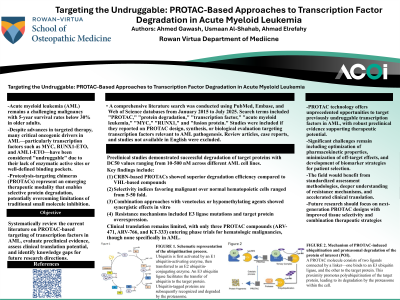
Results/Discussion: Preclinical studies showed effective degradation of target proteins, with DC50 values between 10–500 nM across AML cell lines. Key findings: (1) CRBN-based PROTACs demonstrated greater degradation efficiency than VHL-based compounds; (2) Selectivity indices favoring malignant over normal hematopoietic cells ranged from 5–50-fold; (3) Combination with venetoclax or hypomethylating agents yielded synergistic in vitro effects; (4) Resistance mechanisms included E3 ligase mutations and target overexpression. Clinical translation is limited, with only three PROTACs (ARV-471, ARV-766, KT-333) in phase trials for hematologic malignancies—none yet in AML.
Conclusions: PROTACs offer a promising strategy to target previously undruggable transcription factors in AML. This is supported by strong preclinical data. However, challenges remain, including optimizing pharmacokinetics, minimizing off-target effects, and developing biomarkers for patient selection. Standardized evaluation methods, insights into resistance mechanisms, and clinical translation are needed. Future research should prioritize next-generation PROTACs with better tissue selectivity and explore combination strategies to enhance efficacy.