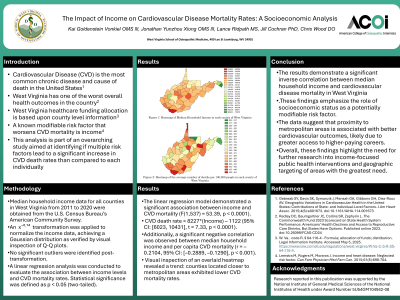
Introduction/Background: Cardiovascular disease (CVD) remains the leading cause of death in the United States. West Virginia consistently ranks among the states with the highest CVD mortality rates. One potential contributing factor is the state's low median household income relative to national averages. Socioeconomic status, particularly income, is a well-established determinant of health outcomes, especially for chronic diseases like CVD. By examining modifiable risk factors such as income, targeted interventions can be developed to mitigate health disparities and reduce disease burden in vulnerable communities.
Methods: Median household income data for all counties in West Virginia from 2011 to 2020 were obtained from the U.S. Census Bureau’s American Community Survey. An x-0.14 transformation was applied to normalize the income data, achieving a Gaussian distribution as verified by visual inspection of Q-Q plots. No significant outliers were identified post-transformation. A linear regression analysis was conducted to evaluate the association between income levels and CVD mortality rates. Statistical significance was defined as p < 0.05 (two-tailed).
Results/Discussion: The linear regression model demonstrated a significant association between income and CVD mortality (F(1,537) = 53.39, p < 0.0001). The relationship was described by the equation y = 8227x – 1484 (95% CI: [6023, 10,321], t = 7.33, p < 0.0001). Additionally, a significant negative correlation was observed between median household income and per capita CVD mortality (r = –0.2104, 95% CI: [–0.2889, –0.1290], p < 0.001). Visual inspection of an overlaid heatmap revealed a trend: counties located closer to metropolitan areas exhibited lower CVD mortality rates.
Conclusions: This analysis demonstrates a significant inverse correlation between median household income and cardiovascular disease mortality in West Virginia. These findings highlight the importance of socioeconomic status as a modifiable risk factor and underscore the need for further investigation into income-targeted public health strategies aimed at reducing CVD-related mortality.