N/A Philadelphia College of Osteopathic Medicine Philadelphia, Pennsylvania, United States
Introduction/Background: Social barriers often limit access to quality care, whether patients are seen by an ambulatory provider or in the emergency department (ED). ED discharge instructions usually recommend a primary care provider (PCP) follow-up, but this intended continuity of care can be limited by insurance, patient availability, or the absence of an established PCP relationship. In ambulatory settings, continuity of care often lapses due to “no-shows” because of social barriers and unanticipated misunderstandings not recognized by the provider’s team.
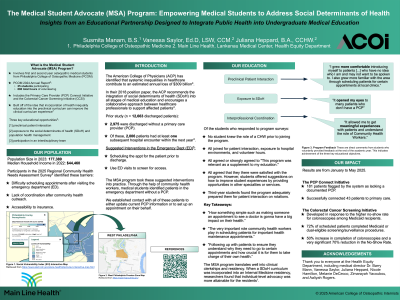
Methods: To screen for these barriers, Main Line Health’s Health Equity department created the PCP Connect Initiative at Lankenau Medical Center in partnership with Medical Student Advocates (MSAs) from Philadelphia College of Osteopathic Medicine (PCOM). Affiliated medical students received a non-clinical opportunity to develop skills in building patient trust, understanding social determinants of health (SDoH), and interprofessional collaboration. Students worked closely with Community Health Workers (CHWs), who are central to the program in conducting SDoH screenings.
Results/Discussion: Outcomes in patient-PCP connections from Lankenau ED were tracked from January to May 2025 and included 181 patients flagged by the system as lacking a documented PCP. MSA students contacted all 181 patients, successfully connecting 43 to primary care. In addition, CHWs and MSAs collaborated on the Colorectal Cancer Screening navigation program to proactively call patients before scheduled colonoscopies to ensure proper follow-through with gastroenterologists. This initiative was developed in response to the higher no-show rate for colonoscopies among Medicaid recipients. As a result, 72% of scheduled patients completed Medicaid or dual-eligible screening/surveillance procedures, indicating a 50% increase and a very significant 70% reduction in the No-Show Rate.
Conclusions: Through the PCP Connect Initiative, PCOM medical students gained early clinical exposure and observed the vital role of CHWs. This experience helped future physicians bridge the gap between the ED and primary care, promoting healthcare continuity and equity.