Student Touro College of Osteopathic Medicine: Middletown NY WIlliamstown, New Jersey, United States
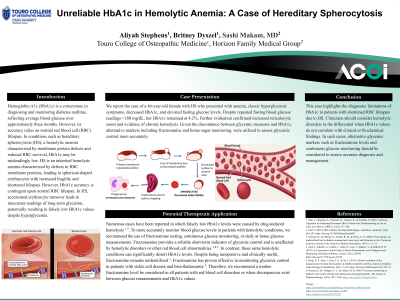
Clinical Scenario or Case: A 46-year-old female with hereditary spherocytosis presented with macrocytic anemia, classic hyperglycemic symptoms, and consistently elevated fasting glucose levels (>130 mg/dL), yet persistently low HbA1c ( < 4.2%). Despite home glucose readings exceeding 180 mg/dL, HbA1c remained falsely low, prompting the use of alternative markers such as fructosamine and home glucose monitoring to better assess glycemic control. The patient was initiated on Mounjaro for weight management, resulting in a 17-pound weight loss and significant improvement in fasting glucose levels, now averaging < 100 mg/dL. Fructosamine stabilized at 210 µmol/L, while HbA1c remained unchanged, underscoring its unreliability in the context of hemolytic anemia.
Evidence/Literature Review: In patients with hereditary spherocytosis, the shortened lifespan of red blood cells can result in falsely low HbA1c values, leading to inaccurate assessments of glycemic control (Pant et al. 2021). In such cases, alternative markers like serum fructosamine provide a more accurate reflection of glycemic status, as they are not affected by red cell turnover (Youssef et al. 2008, John et al. 2023). Fructosamine levels correlate well with mean glucose over the prior 2–3 weeks and have demonstrated utility in both pediatric and adult populations with altered erythrocyte dynamics (Kang et al. 2015, Kosecki et al. 2005). Therefore, in hereditary spherocytosis, clinicians should consider fructosamine testing to avoid underestimation of glycemic control.
Unique Aspects of Case: This case is unique because it highlights the diagnostic challenge of interpreting HbA1c levels in a patient with hereditary spherocytosis, despite HbA1c being the standard of care for monitoring glycemic control. It underscores the importance of recognizing hemolytic disorders as a confounding factor in diabetes management and demonstrates the clinical value of alternative markers like fructosamine in such scenarios.
Recommendations/Conclusions: Routine fructosamine level should be considered in all patients with red blood cell disorders or when discrepancies exist between glucose measurements and HbA1c values.