Medical Student Rocky Vista University College of Osteopathic Medicine Denver, Colorado, United States
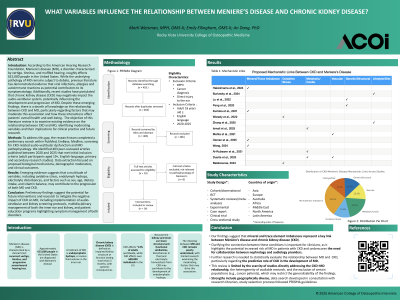
Introduction/Background: According to the American Hearing Research Foundation, Meniere’s disease (MD), a disorder characterized by vertigo, tinnitus, and muffled hearing, roughly effects 615,000 people in the United States. While the underlying pathology of MD remains subject to debate, previous literature has demonstrated evidence that viral infections, allergies and autoimmune reactions as potential contributors to its symptomatology. Additionally, recent studies have postulated that chronic kidney disease (CKD) may negatively impact the audio-vestibular system, potentially influencing the development and progression of MD. Despite these emerging findings, there is a dearth of knowledge on the relationship between CKD and MD, particularly regarding factors that may moderate this association and how these interactions affect patients' overall health and well-being. The objective of this literature review is to examine existing evidence on the relationship between CKD and MD, identifying moderating variables and their implications for clinical practice and future research.
Methods: To address this gap, the research team completed a preliminary search within PubMed, screening for CKD-related audio-vestibular dysfunction and MD pathophysiology. We identified 45 peer-reviewed articles published between 2020 and 2025 that met initial inclusion criteria (adult participants aged 19+, English-language). The literature search is ongoing, with additional searches planned in Embase and Google Scholar. Data extraction will focus on proposed biological mechanisms, demographic moderators, and clinical outcomes.
Results/Discussion: Emerging evidence suggests that a multitude of variables, including oxidative stress, endolymph hydrops, electrolyte disturbances, and factors such as sex, age, dietary intake, and vitamin balance, may contribute to the progression of both MD and CKD.
Conclusions: Preliminary findings suggest the potential for future interventions and research to mitigate the negative impact of CKD on MD, including implementation of audio-vestibular and kidney screening protocols, multidisciplinary management of both the inner ear and kidney, and patient education programs highlighting symptom management of both disorders.