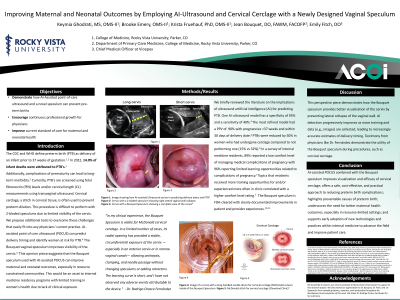
Introduction/Background: The Bouquet speculum is a vaginal speculum that improves patient comfort and physician visibility during vaginal exams and procedures, such as Pap smears and cervical cerclage. It has demonstrated improved cervical cancer screening and treatment in resource-constrained areas with limited training. Its application extends to AI-assisted point-of-care ultrasound (POCUS). Recent studies exploring the use of AI-assisted POCUS to identify women at risk for preterm delivery have provided more accurate due dates. Currently, cervical cerclage can be performed to postpone delivery but is challenging to perform with 2-bladed vaginal speculums due to vaginal wall collapse. For less than $3, the Bouquet vaginal speculum in combination with AI-assisted POCUS can improve maternal health, especially in resource constrained communities.
Methods: A literature review was performed on the implications of utilizing ultrasound artificial intelligence (AI) for cervical cerclage procedures with the Bouquet speculum. Statistical data supporting this analysis were obtained from contributions of Dr. Rodrigo Fernandez’s work.
Results/Discussion: The Bouquet speculum provides greater visibility, ease of use, and patient comfort when performing the cervical cerclage. Utilizing Ultrasound AI to identify women at risk for preterm delivery allows for early intervention and improved efficacy of cervical cerclage with the Bouquet speculum.
Conclusions: The concerted use of AI-assisted POCUS with the Bouquet speculum has a four-fold impact. Internists in any subspecialty can benefit from learning about the application of these tools to provide better care for pregnant patients. This technology overcomes the limitations of 2-bladed speculums for cervical cerclage. These tools demonstrate an accurate, cost-effective, safe, and practical means to decrease mortality and morbidity associated with premature deliveries. Furthermore, it brings increased attention to preventable causes of preterm birth in resource-restricted settings and emphasizes the need to improve maternal health outcomes.