Student Nova Southeastern University Fort Lauderdale, Florida, United States
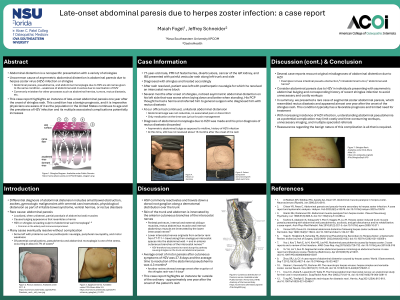
Clinical Scenario or Case: A 77-year-old man presented to his PCP with a painful vesicular rash on his left trunk and was diagnosed with shingles. After appropriate treatment, he developed postherpetic neuralgia and received an intercostal nerve block. Soon after, he noticed asymmetric abdominal distention on the left side, which worsened when lying down. He was referred to a general surgeon for a suspected hernia but was diagnosed with rectus diastasis. The distention persisted, prompting a visit to our office. Based on his history of truncal HZV and physical examination findings of unilateral, asymmetric, distention, a diagnosis of abdominal monoplegia was ultimately made.
Evidence/Literature Review: Abdominal paresis is a weakness of the abdominal wall muscles caused by reactivation of HZV. The lower intercostal nerves, which innervate muscles like the obliques and rectus abdominis, end as anterior cutaneous branches supplying the trunk’s skin. HZV can reactivate in a dorsal root ganglion and travel this nerve path, causing shingles and, in some cases, abdominal paresis. Several case studies report this as a rare short- and long-term complication.
Unique Aspects of Case: Two systematic reviews of available case studies found the average onset of motor paresis after HZV rash to be 27.6 and 14 days. In this case, abdominal distention appeared about one year later, well beyond the typical timeframe, highlighting an unusually delayed motor complication following HZV infection and emphasizing an important diagnostic consideration for physicians.
Recommendations/Conclusions: We presented a rare case of segmental zoster abdominal paresis, which resembled rectus diastasis and appeared almost one year after the onset of the shingles rash, a period far outside of the ordinary. This condition typically has a favorable prognosis and limited need for treatment. With the increasing incidence of HZV infection as the population ages, understanding abdominal pseudohernia as a potential complication may limit costly and time-consuming workups, unnecessary imaging, and multiple specialist referrals.