Medical Student Edward Via College of Osteopathic Medicine-Carolinas Spartanburg, North Carolina, United States
Clinical Scenario or Case: A 23-year-old male with ADHD, Wolff-Parkinson-White syndrome, and silica exposure presented with months of throat swelling, nasal congestion, and a persistent neck lump. Initially misdiagnosed with allergic rhinitis and dermatofibroma, was treated with pseudoephedrine and referred to ENT.
On July 16, 2024, he was treated for oral candidiasis and tested negative for mononucleosis; fluconazole was prescribed. He returned to the ER on August 11 with worsening symptoms, including bloody sputum. Despite treatment for presumed allergic rhinitis, imaging was ordered.
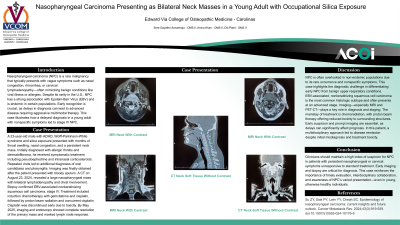
By August 14, acute pharyngitis and possible tonsillitis were suspected, and antibiotics prescribed. A contrast CT on August 23 revealed a malignant nasopharyngeal mass with bilateral lymphadenopathy and clival sclerosis. MRI on August 27 confirmed a large mass with cervical adenopathy.
ENT evaluation on September 5 included flexible endoscopy and biopsy. Flow cytometry and pathology confirmed EBV-associated, nonkeratinizing squamous cell carcinoma, stage IV, with lymph node metastasis. PET-CT showed a large mucosal malignancy with bilateral nodal spread.
The patient began induction chemotherapy with gemcitabine and cisplatin, followed by proton beam radiation with weekly cisplatin starting January 6, 2025. Cisplatin was stopped after three doses due to intolerance, but radiation continued. Imaging on April 18 showed no residual mass and reduced lymphadenopathy. By May 14, the primary tumor had resolved, though clival sclerosis and edema remained. A rigid nasal endoscopy on May 22 was unremarkable, and he was referred to Head and Neck Surgery and Speech-Language Pathology.
Evidence/Literature Review: Nasopharyngeal carcinoma, a rare cancer of the nasopharynx, with fewer than one case per 100,000 annually in the U.S., usually diagnosed around age 55. Risk factors include genetics, environmental exposures, and Epstein-Barr Virus.
Unique Aspects of Case: This case involves a younger patient, age 23, with a history of silica exposure.
Recommendations/Conclusions: Case highlights the diagnostic challenges of NPC and the value of thorough evaluation in achieving a positive outcome.