Internal Medicine Orlando College of Osteopathic Medicine Winter Garden, Florida, United States
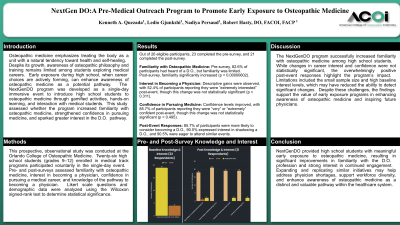
Introduction/Background: In the United States, physicians are trained as either Doctors of Medicine (M.D.) or Doctors of Osteopathic Medicine (D.O.). While the osteopathic profession continues to grow, with D.O. students comprising 28% of all U.S. medical students in 2023–2024, early exposure to this career pathway remains limited. Experiential programs have demonstrated value in fostering interest in medicine, but few focus specifically on osteopathic medicine. This study evaluated the impact of NextGenDO, a single-day immersive program designed to introduce high school students to osteopathic medicine through experiential learning and engagement with osteopathic medical students.
Methods: This prospective, observational study enrolled 26 high school students (grades 9–12). Pre- and post-event surveys assessed demographics, baseline knowledge, interest in medicine, and familiarity with osteopathic medicine using Likert scales. Twenty-three students (88.5%) completed pre-surveys, and 21 (80.8%) completed post-surveys. Data were analyzed using descriptive statistics and Wilcoxon signed-rank tests.
Results/Discussion: Prior to the event, 82.6% of participants had heard of a D.O., though most reported only slight-to-moderate familiarity. Post-event, all participants reported improved understanding of osteopathic medicine, and 85.7% stated they were more likely to consider becoming a D.O. Significant increases were observed in familiarity with osteopathic medicine (mean pre 2.65 vs. post 4.14; p = 0.00000602). While mean scores increased for interest in medicine (3.57 → 3.95), confidence in pursuing a medical career (3.96 → 4.14), and confidence in knowledge of the physician pathway (3.48 → 3.90), these changes did not reach statistical significance.
Conclusions: The NextGenDO program significantly improved high school students’ familiarity with osteopathic medicine and increased their likelihood of considering this pathway. Early, osteopathic-focused outreach may serve as a valuable strategy to raise awareness, encourage diversity in the physician workforce, and address the growing physician shortage.