Student VCOM-CC Greenwood, South Carolina, United States
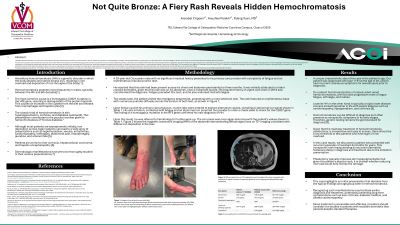
Clinical Scenario or Case: A 29 year old Caucasian male presented to his primary care provider (PCP) with complaints of an erythematous and pruritic rash that was present across his chest and abdomen, and dry, scaly hands. He was treated with steroids with temporary improvement. 2 weeks later, the patient visited the emergency department, presenting with a beefy, red, and pustular rash diffusely across both feet. Due to recent irritant exposure of new laundry detergent and sawdust, his rash was assumed to be eczematous, and he was given steroids and antibiotics due to a few open sores observed. Upon returning to his PCP for follow up, routine labs revealed an elevated iron level, at 208. In conjunction with his skin irritation, a cheek swab was ordered to check for the C282Y gene. This prompted his new diagnosis of Hereditary Hemochromatosis. The patient was referred to hematology for further investigation. MRI of the abdomen revealed diffuse iron deposition in the liver. Weekly phlebotomy was started to reduce total body iron stores.
Evidence/Literature Review: Hereditary Hemochromatosis is an autosomal recessive genetic disorder characterized by excessive iron accumulation in tissues. Classic early symptoms include fatigue, arthralgia and abdominal pain. Skin findings typically include hyperpigmentation, hypertrichosis and resistant pruritus.
Unique Aspects of Case: This case is uniquely seen in a 29 year old male, whereas the median age of males diagnosed with hemochromatosis is 40-60 years old. It highlights the atypical initial finding of recurrent dermatitis. Of note, this patient had recurring rashes with similar characteristics over 4 years prior to diagnosis.
Recommendations/Conclusions: Recognizing atypical presentations of Hereditary Hemochromatosis may facilitate earlier diagnosis and treatment, potentially preventing long-term complications such as liver cirrhosis, diabetes mellitus and dilated cardiomyopathy. Physicians should consider iron studies in patients with dermatitis that is persistent despite standard therapies.