Internal Medicine Orlando College of Osteopathic Medicine Winter Garden, Florida, United States
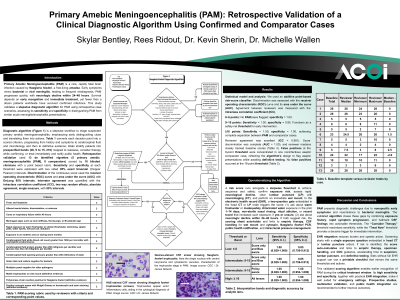
Introduction/Background: Primary Amebic Meningoencephalitis (PAM) is a rare but nearly always fatal CNS infection caused by Naegleria fowleri. Early symptoms are often indistinguishable from bacterial or viral meningitis, leading to frequent misdiagnosis and delays in treatment. Because outcomes depend on rapid recognition and intervention, tools that raise early clinical suspicion are urgently needed. This study aims to evaluate the performance of a stepwise clinical algorithm designed to identify suspected PAM early, using retrospective case vignettes scored by reviewers with medical training.
Methods: Ten medically trained reviewers independently scored 13 anonymized cases (5 confirmed PAM, 8 mimics including bacterial and aseptic meningitis) using a 31-point rubric derived from the algorithm. A total score of ≥8 indicated high probability of PAM and the need for immediate empiric therapy. We assessed sensitivity, specificity, inter-rater reliability, and variability across reviewers.
Results/Discussion: The algorithm flagged all 5 PAM cases (sensitivity 100%) and correctly ruled out 6 of 8 non-PAM comparators (specificity 75%). Reviewer agreement was high (ICC ≈ 0.98; Fleiss’ κ ≈ 0.72). PAM cases consistently received high scores (mean range: 21.1–27.8), while non-PAM cases scored substantially lower (mean range: 3.0–10.2). The two false positives shared overlapping features with PAM and represent recognizable patterns for future calibration. Outlier analysis revealed a small number of reviewer-case mismatches, including one reviewer with a tendency to under-score.
Conclusions: This algorithm showed strong potential as a triage tool for early identification of PAM. It was highly sensitive, reproducible, and able to distinguish PAM from similar presentations. With minor calibration, it could be integrated into emergency care protocols or decision-support tools to reduce diagnostic delays and improve outcomes. Further prospective testing is recommended.