Internal Medicine Oklahoma State University Medical Center Tulsa, Oklahoma, United States
Clinical Scenario or Case: Cushing syndrome caused by excess endogenous cortisol is rare, with an annual incidence of 8 per million people.¹ Ectopic Cushing syndrome (ECT-CS) accounts for about 10% of cases.²,³ Extrapulmonary neuroendocrine tumors (NETs) are a particularly rare source⁴ and present unique diagnostic and therapeutic challenges. Research shows ECT-CS often presents with metastatic disease (27–40%), with extrapulmonary NETs more likely to metastasize than bronchial carcinoids.⁴,⁵ These cases also involve severe hypercortisolism, leading to life-threatening infections and cardiovascular complications. Prognosis is worse in extrapulmonary ECT-CS compared to pulmonary sources.⁴,⁵ Internists must be familiar with effective medical therapies to manage hormone excess and stabilize patients.⁵,⁶
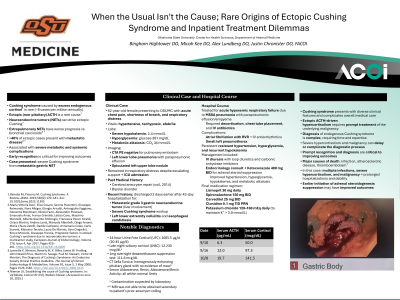
Evidence/Literature Review: A 62-year-old woman with metastatic gastric NET and newly diagnosed hypercortisolism presented in acute respiratory distress. She required ICU admission, IV antibiotics, and surgical intervention for MSSA pneumonia with empyema. Her course was further complicated by profound hypokalemia, hyperglycemia, and resistant hypertension. Medical stabilization required aggressive electrolyte repletion and steroidogenesis suppression with Ketoconazole.
Unique Aspects of Case: While most ectopic ACTH production arises from bronchial or pancreatic NETs, this case highlights a rare gastric origin. Consistent with literature, the patient’s extrapulmonary tumor presented with advanced metastatic disease and severe hypercortisolism-related complications. Surgical resection was not feasible, necessitating inpatient medical management to suppress cortisol and permit oncologic therapy.
Recommendations/Conclusions: In patients with severe ECT-CS, particularly from extrapulmonary NETs, early initiation of steroidogenesis inhibitors should be prioritized.⁵,⁶ Medical therapy may reduce cortisol-driven morbidity and improve eligibility for cancer-directed treatment.6,7,8,9 Delays in hormonal control can prolong hospitalization and worsen outcomes. Internists managing complex inpatients should consider prompt adrenal blockade when definitive diagnosis or surgical intervention is not immediately available.