Student TouroCOM Middletown, NY Pottstown, Pennsylvania, United States
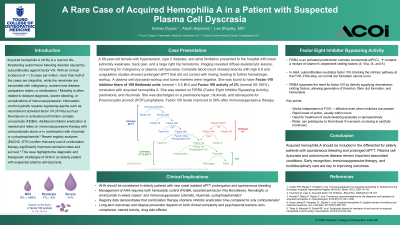
Clinical Scenario or Case: A 66-year-old woman with hypertension, type 2 diabetes, and atrial fibrillation presented with lower extremity weakness, anemia, and back pain. Imaging revealed diffuse skeletal lytic lesions, concerning for malignancy or plasma cell dyscrasia. Coagulation studies showed prolonged aPTT that did not correct with mixing, leading to hematologic workup. She was found to have factor VIII inhibitor titers of 189 Bethesda units and factor VIII activity of 2%, consistent with acquired hemophilia A. She was started on FIEBA, prednisone, and rituximab. Due to limited follow-up and partial noncompliance, steroid tapering was delayed. However, factor VIII levels improved to 58% after immunosuppressive therapy.
Evidence/Literature Review: AHA is a rare bleeding disorder with 1.5 cases per million annually (Franchini & Lippi 2008). Over 50% cases are idiopathic, the remainder are associated with malignancy, autoimmune disorders, or postpartum states (Kruse-Jarres 2017). High-titer inhibitors are linked to more severe bleeding and require treatment with bypassing agents such as FEIBA or recombinant activated factor VII (Collins et al. 2012). The EACH2 registry demonstrated early use of corticosteroids, alone or in combination with rituximab, significantly improves inhibitor eradication (Collins 2012).
Unique Aspects of Case: Patient presented with lytic lesions and bleeding, prompting a broad differential including plasma cell dyscrasia and autoimmune coagulopathy. Despite high inhibitor titer, she responded well to immunosuppressive therapy. The case showcases overlap of hematologic and autoimmune features, steroid complications, and challenges of managing compliance in a complex patient.
Recommendations/Conclusions: AHA should be considered in elderly patients with spontaneous bleeding and isolated aPTT prolongation. Early diagnosis using mixing studies and factor assays followed by immunosuppressive therapy is essential. Interdisciplinary care and patient education are key for long-term management and relapse prevention. This case highlights the need for evaluating bleeding in older adults with a broad differential.