Internal Medicine Kansas City University Joplin, Missouri, United States
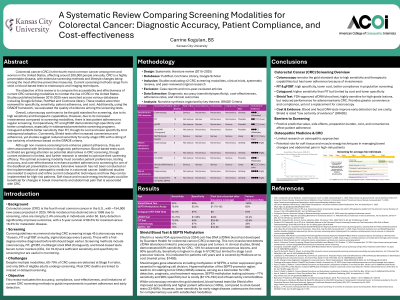
Introduction/Background: Colorectal cancer (CRC) is the fourth most common cancer among men and women in the United States, affecting around 200,000 people annually. Despite its prevalence, CRC is highly preventable with appropriate screening methods and lifestyle interventions. Current screening methods range from stool or blood-based tests to endoscopic and imaging techniques.
Methods: This review aims to compare the accessibility and effectiveness of current CRC screening modalities. Studies published between 2015-2025 were searched across databases including Google Scholar, PubMed and Cochrane library. These studies were reviewed for test accuracy, patient adherence, and cost. The GRADE framework was used to evaluate the quality of evidence among screening tests.
Results/Discussion: Overall, colonoscopy continues to be the gold standard for screening, due to its high sensitivity and therapeutic capabilities. However, due to its invasive nature compared to other screening modalities, there is less adherence to regular screening. Comparatively, FIT and gFOBT demonstrate high specificity and better compliance, especially in widespread preventative screening programs. Cologuard exhibits better sensitivity than FIT, though its cost and lower specificity limit widespread adoption. Shield tests offer increased convenience and adherence, yet studies suggest lower sensitivity for early-stage CRC and a low certainty of evidence based on the GRADE criteria.
Conclusions: Although non-invasive tests enhance patient adherence, they are associated with limitations in diagnostic performance. Blood-based tests such as Shield are gaining attention as potential alternatives in CRC screening, though current evidence is limited, and further research is needed to optimize its efficacy. The optimal screening modality must consider patient preferences, testing accuracy, and cost-effectiveness to enhance adherence for one of the deadliest yet preventable cancers. Additional studies should be implemented to explore and refine osteopathic techniques and integrated as adjunctive therapy for high-risk patients. Soft tissue and muscle energy techniques could be beneficial for bowel changes and abdominal pain associated with CRC.