Medical Student Future Forwards Research Institute Stratford, New Jersey, United States
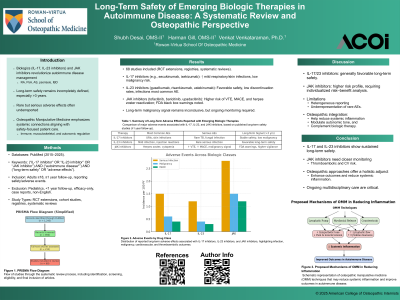
Introduction/Background: Interleukin‑17 (IL‑17) inhibitors, IL‑23 inhibitors, and Janus kinase (JAK) inhibitors have reshaped the management of autoimmune diseases. While initial clinical trials provided safety data up to 1 year, comprehensive long-term safety profiles across multiple disease states are still evolving. This systematic review evaluates serious infections, malignancy, major adverse cardiovascular events (MACE), venous thromboembolic events (VTE), and other safety concerns in adult patients treated with specific agents.
Methods: We conducted a PubMed search (2015–2025) using terms for biologic and JAK inhibitors, autoimmune conditions, and long-term safety metrics. We included long-term RCT extensions, pooled analyses, registries, and observational studies with ≥1 year of follow-up. Outcomes of interest were incident rates or hazard ratios for serious infection, malignancy, MACE, VTE, and mortality. Excluded were short-term studies ( < 1 year), case reports, and non-safety-focused reports.
Results/Discussion: IL-17 inhibitors showed low long-term rates of serious infections, MACE, and IBD flares over 5 years. JAK inhibitors were linked to higher risks of malignancy and cardiovascular events, especially in older or high-risk patients. IL-23 inhibitors had limited data beyond 3 years but showed favorable early results. These findings highlight the need for continued surveillance and individualized analysis when selecting long-term biologic therapy. Additionally, OMM lymphatic and MFR techniques were found to be helpful in managing pain and reducing inflammation.
Conclusions: Emerging biologic therapies have diverse long-term safety profiles. While IL-17 and IL-23 showed promising statistics and maintained excellent safety across diseases, JAK inhibitors showed increased long term risks. As a result, it is vital to continue further research in order to create indivdualized risk assessments and gain more knowledge into the full safety profiles of these drugs. Furthermore, OMM lymphatic and MFR techniques were found to be helpful in managing pain and reducing inflammation inviting new research to be done looking at combination therapies and its effectiveness.